
Sewer Line Repair in Cerritos, CA
Sewer Line Repair Solutions connects Cerritos homeowners with local sewer line professionals — camera diagnosis, trenchless repair, and round-the-clock emergency response. Sewer line repair in Cerritos, CA starts with one call: (833) 713-2101.
- 24/7 emergency line
- Southeast LA County specialists
- Free to call
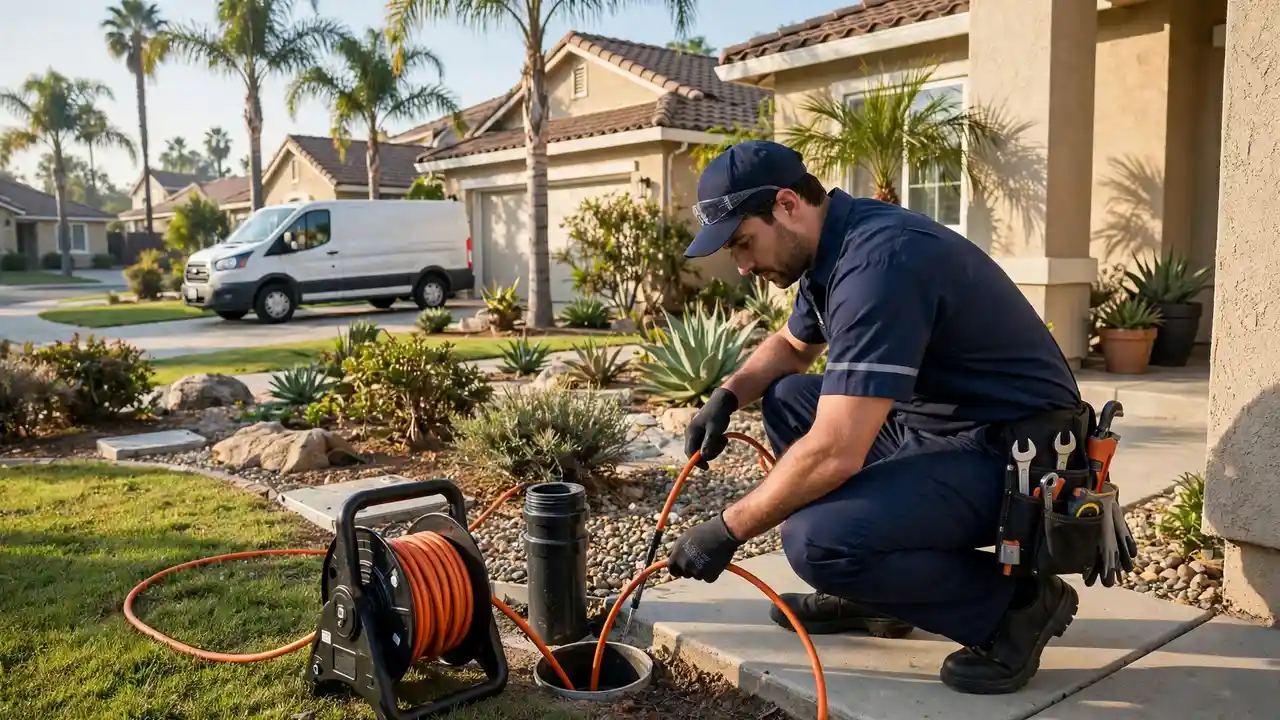
Most of the sewer pipe under Cerritos and the surrounding Gateway Cities was buried during the postwar housing boom, and it was never designed to last this long. The 1950s Lakewood and Downey tracts went in with vitrified clay tile laterals; the 1960s and 70s subdivisions of Cerritos, Norwalk, La Mirada, and Buena Park followed with the same clay tile, joined by bell-and-spigot connections whose sealing materials harden, shrink, and crack with age. Above them stand the mature ficus, sycamore, and parkway trees planted when the tracts were new — five decades of roots that treat every weakened joint as a water source. Underneath, the alluvial sandy-loam soils of the LA basin shift and settle through wet winters and dry summers, nudging pipe sections out of alignment a fraction of an inch at a time.
The failure pattern in Southern California follows the weather. Through the Mediterranean dry summer, thirsty roots push deeper and find the moisture inside the lateral. Then the first atmospheric-river storms of November through March saturate the sandy loam, groundwater forces its way into every cracked joint, and the overloaded line surcharges. Because local homes sit on concrete slabs — there are no basements here — the first sign of a failing lateral is not a flooded lower level but a shower that will not drain, a tub that fills when the washer runs, or a yard cleanout that pushes sewage onto the lawn. Sewer Line Repair Solutions exists for exactly that moment: one call to (833) 713-2101 connects Cerritos homeowners with a local sewer professional who puts a camera in the line before recommending anything, and fixes it with the least disruptive method that will actually hold.
The service area runs from Cerritos across the Gateway Cities and into north Orange County — Anaheim, Artesia, Bellflower, Buena Park, Carson, Compton, Cypress, Downey, Fullerton, Garden Grove, Hawaiian Gardens, La Mirada, La Palma, Lakewood, Long Beach, Los Alamitos, Norwalk, Paramount, Santa Fe Springs, Signal Hill, Stanton, and Whittier. A midnight backup in a 1958 Downey ranch, a planned trenchless lining for a Cerritos townhome, a camera inspection before buying on the Signal Hill slopes — the process starts the same way every time: a conversation about what the drains are doing, and a repair plan drawn from what the camera actually shows.
One more local detail shapes every job here. With no basements, the lateral runs under the slab to a cleanout near the front walk or driveway, so access planning matters as much as method selection. The camera survey starts at that cleanout whenever one exists, and when a section has to be replaced, the route is chosen to protect the slab, the driveway, and the mature landscaping the neighborhood is known for. That is the whole approach in one sentence: look first, dig only where the camera says the problem is, and leave the property the way it was found.
Sewer Problems Cerritos Homeowners Actually Face
Root intrusion at clay tile joints
The dominant failure pattern across the Gateway Cities. Clay tile joints from the 1950s–70s separate a fraction of an inch over decades of wet-dry soil cycles, and mature ficus, sycamore, and parkway trees send root hairs into every opening. Through the long dry summer those roots grow aggressively toward the moisture inside the pipe; within a few seasons, hairs become mats, mats become blockages, and a line that drained fine for decades backs up every year or two. Camera inspection finds the entry joints; cutting clears them and lining seals them.
Offset and settled joints in sandy-loam soils
The LA basin's alluvial sandy loam compacts unevenly under old trenches, and pipe sections settle at different rates. The result is offset joints and low spots — bellies — that hold standing water and solids. Jetting passes through a belly and the debris resettles within months, so the camera measures the sag first: shallow offsets can sometimes be lined, deep ones need the grade rebuilt by replacement.
Cast iron failing under the slab
In most 1950s–70s local homes, the drain piping inside the house is cast iron, and it fails from the inside out. Scale roughens the interior until paper and waste snag; corrosion thins the bottom of the pipe until it disappears. Because there is no basement to work from, repairs mean either lining the pipe in place or tunneling beneath the slab — both start with a camera survey that maps exactly which sections are gone.
Orangeburg pipe reaching end of life
Bituminous fiber pipe — installed in parts of the postwar boom from the mid-1940s through the early 1970s — was never meant to see sixty-plus years. It ovals under soil pressure, blisters from the inside, and eventually collapses into a flattened channel. Pockets of Orangeburg remain in the oldest tracts of Compton, Downey, and surrounding neighborhoods; when the camera shows the deformation, pipe bursting is the standard replacement.
Storm-season infiltration, November to March
Cracked joints do not only let sewage out — they let groundwater in. When atmospheric-river storms saturate the sandy loam, water pours into breached laterals and surcharges lines that behaved all summer. Near the Long Beach coast, a naturally high water table makes the problem year-round. Infiltration calls for joint sealing by lining, and in low-lying homes, backwater-valve protection against the surcharge.
Hillside and coastal conditions
Laterals stepping down the slopes of Signal Hill and east Whittier fight gravity and geology: joints offset as the hillside creeps, and long runs develop low spots that collect solids. Near the coast, salt-laden moisture accelerates corrosion of metal pipe and fittings. Both settings punish generic repairs — the camera survey has to map slope, offsets, and water table before the method is chosen.
Sewer Line Services in Cerritos, CA
Commercial Sewer Services
Camera inspection, hydro jetting, and grease-line service for restaurants, offices, and retail — scheduled around your operating hours, with written findings.
Learn moreEmergency Sewer Repair
Backups and overflows answered around the clock. The first priority on every call is stopping the damage and getting flow restored.
Learn morePipe Bursting
Breaks the failed pipe apart underground and pulls new HDPE through the same path — a full replacement reached through two small pits.
Learn morePipe Lining
CIPP lining forms a smooth, jointless new pipe inside the old one. No trench across the yard, and most homes are finished in a day.
Learn moreSewer Camera Inspection
Watch the inside of your lateral on a live monitor before spending on repairs: exact defect locations, pipe material, and a written report.
Learn moreSewer Leak Detection
Camera, acoustic, and locating equipment pin down the exact break — so the repair targets one section instead of the whole line.
Learn moreSewer Line Cleaning
Hydro jetting and root cutting clear grease, scale, and root mats, restoring the pipe to its full diameter without digging.
Learn moreSewer Line Installation
New laterals for new construction, additions, and ADUs — set to grade in modern materials with a camera-verified finish.
Learn moreSewer Line Replacement
When patching stops making sense: a brand-new lateral by trenchless bursting or open-cut, built for decades of service.
Learn moreSewer Maintenance
Scheduled cleaning, camera checks, and root management matched to your pipe's age — maintenance instead of emergency calls.
Learn moreTree Root Removal
Cuts intruding roots and treats the joints they came through — the fix that ficus and sycamore country in Southern California asks for most.
Learn moreTrenchless Sewer Repair
Lining and bursting renew or replace the line through small access points, leaving the slab, driveway, and landscaping intact.
Learn moreFrom First Call to Fixed Line
- 1Call (833) 713-2101 — any hour
Describe what the drains are doing: which fixtures are affected, when it started, and roughly how old the home is. A local specialist answers, asks the questions that narrow down the cause, and tells you what to do — or avoid doing — until help arrives.
- 2Get a camera diagnosis
The technician sends a camera through the lateral and locates every defect from the surface. You watch the problem on the monitor and receive a written findings report — evidence first, recommendations second.
- 3Fix it with the right method
Jetting, lining, bursting, or replacement: the recommendation matches what the camera showed, and the work is scheduled around your household. Most residential jobs finish within a day.
Why Cerritos Calls (833) 713-2101
A referral service, not a sales call
Sewer Line Repair Solutions connects callers with independent local sewer professionals. Describe the problem once and get connected with someone who serves Cerritos and the Gateway Cities — no phone trees, no pressure tactics.
Camera-first, every time
Every recommendation is scoped from video evidence. The camera shows the pipe material, the defects, and their exact locations before anyone suggests lining, bursting, or digging — the way you avoid paying for the wrong fix.
Trenchless options where they fit
Pipe lining and pipe bursting resolve most residential failures without an open trench across the yard. When the camera shows trenchless is viable, the slab, driveway, and landscaping stay undisturbed.
Built for SoCal's housing stock
Clay tile laterals, cast iron under the slab, Orangeburg in the oldest tracts, and the root pressure of mature ficus and parkway trees — the local specialists work on this exact mix of pipe and soil every day, from 1950s Lakewood ranches to hillside laterals in Signal Hill.
One number, day and night
Sewer failures do not keep business hours. The line at (833) 713-2101 is answered around the clock, so a backup at midnight gets a plan at midnight — not Monday morning.
Sewer Line Repair Across Cerritos and the Gateway Cities
Sewer work is local work. The lateral under a 1954 Lakewood ranch — clay tile, shallow, threaded through by ficus roots — has little in common with a hillside lateral stepping down Signal Hill or a coastal line in Long Beach sitting in a high water table. Service across Cerritos and the surrounding cities is organized around those differences: the housing era, the pipe material it implies, and the soil, trees, and water conditions above it.
Pick your community below for the local picture: the verified ZIP, the typical housing stock, the pipe materials usually found there, and how each service adapts to the area's conditions.
Every area page also notes the services requested most often there — because the right fix for root-choked clay tile in Downey is rarely the right fix for a settled hillside lateral in Whittier.
Anaheim
West Anaheim tracts (92804) mix 1950s–70s clay tile with early PVC; mature street trees keep root calls steady.
Learn moreArtesia
Compact 1950s–60s lots in 90701 with short clay tile laterals — root intrusion and joint-offset country.
Learn moreBellflower
Postwar tracts in 90706 with shallow clay tile runs; summer root growth and winter storm infiltration drive the service mix.
Learn moreBuena Park
1950s–60s subdivisions in 90620 on sandy-loam soils where clay tile joints settle and separate over the decades.
Learn moreCarson
1960s–70s homes in 90745 pairing cast iron under the slab with clay tile outside — both now in their replacement window.
Learn moreCompton
Older housing stock in 90220 with clay tile and some remaining Orangeburg; camera inspection settles material questions fast.
Learn moreCypress
1970s–80s neighborhoods in 90630 where clay tile meets PVC at transition joints — sectional lining territory.
Learn moreDowney
The classic 1950s tracts of 90241: clay tile laterals under 70-year-old street trees, textbook root-intrusion ground.
Learn moreFullerton
Mixed eras in 92833, from older clay tile near the core to newer PVC; pre-purchase camera inspections are common here.
Learn moreGarden Grove
1950s–60s tracts in 92843 with clay tile laterals and heavy ficus planting along the parkways.
Learn moreHawaiian Gardens
Compact older stock in 90716 with short, shallow laterals — cleaning and spot repair keep most lines running.
Learn moreLa Mirada
1960s–70s planned tracts in 90638 with clay tile laterals now crossing the 50-year mark together.
Learn moreLa Palma
1960s–70s neighborhoods in 90623 where aging clay tile joints and mature landscaping reach the same decision point.
Learn moreLakewood
The landmark 1950–54 Lakewood tract in 90715: clay tile laterals at 70+ years, the highest-probability replacement ground in the area.
Learn moreLong Beach
East Long Beach (90808) pairs 1950s–60s clay tile with a high coastal water table — infiltration and corrosion territory.
Learn moreLos Alamitos
1970s–80s homes in 90720 with mostly PVC laterals; foundation penetrations and yard drains cause more trouble than the pipe itself.
Learn moreNorwalk
1950s–60s tracts in 90650 with clay tile laterals and dense parkway trees — root management is the standing program.
Learn moreParamount
Postwar homes in 90723 with clay tile laterals showing the usual joint separation after six decades of wet-dry cycles.
Learn moreSanta Fe Springs
A commercial-residential mix in 90670: restaurant grease lines and jetting contracts alongside 1960s residential clay tile.
Learn moreSignal Hill
Hillside laterals in 90755 stepping down the slope — offset joints and settlement get camera-verified before any repair.
Learn moreStanton
1950s–60s tracts in 90680 with clay tile laterals; ficus and sycamore roots are the repeat offenders.
Learn moreWhittier
An older core plus hillside neighborhoods in 90604: long clay tile runs, slope settlement, and mature tree cover.
Learn moreSewer Line Guides for Southeast LA County Homeowners
Signs Your Sewer Line Is Failing
Warning signs your lateral is failing.
Learn moreTree Roots in Your Sewer Line: Why It Happens and What to Do
Why roots invade and how to stop them.
Learn moreTrenchless vs. Traditional Sewer Repair
Trenchless vs. digging: honest comparison.
Learn moreSewer Line Repair vs Replacement: How Cerritos Owners Decide
Repair or replace? How to decide.
Learn moreSewer Backup Emergency: What to Do Right Now
Exact steps during a sewage backup.
Learn moreSewer Line Maintenance Tips for Cerritos Homeowners
Habits that keep sewers flowing.
Learn moreFrequently Asked Questions
How does Sewer Line Repair Solutions work?
It is a referral service: you call (833) 713-2101, describe the sewer problem and where the property sits, and you are connected with an independent local sewer professional serving Cerritos and the surrounding cities. The specialist who arrives handles diagnosis and repair directly.
What areas do you serve?
Cerritos and the Gateway Cities — Anaheim, Artesia, Bellflower, Buena Park, Carson, Compton, Cypress, Downey, Fullerton, Garden Grove, Hawaiian Gardens, La Mirada, La Palma, Lakewood, Long Beach, Los Alamitos, Norwalk, Paramount, Santa Fe Springs, Signal Hill, Stanton, and Whittier.
Do you offer emergency service around the clock?
Yes. The line at (833) 713-2101 is answered at any hour. Sewage backups, overflows, and sudden line failures are prioritized, and the first call focuses on stopping the damage before discussing permanent repairs.
Will you have to dig up my yard?
Often not. Most residential failures in this area qualify for trenchless methods — pipe lining or pipe bursting — which work through small access points instead of an open trench. A camera inspection determines whether your line is a candidate before anyone commits to a method.
Why do sewers fail here if the weather never freezes?
Southern California trades freeze-thaw for its own stresses: thirsty roots hunt sewer moisture through long dry summers, sandy-loam soils shift with wet-dry cycles, and atmospheric-river storms from November to March drive groundwater into every cracked joint. Clay tile joints separate slowly instead of suddenly — but the outcome is the same.
Do tree roots really cause most sewer problems here?
Across much of the service area, yes. Clay tile joints from the 1950s–70s separate over the decades, and mature ficus, sycamore, and parkway trees send roots into every opening. Root cutting combined with joint repair — lining or a managed cutting program — is the standard answer.
Can you handle commercial properties?
Yes — restaurants, offices, retail, and industrial properties receive scheduled service: camera inspection, hydro jetting, grease-line clearing, and lateral repair planned around operating hours, with written documentation.
What should I do during a sewage backup right now?
Stop using water immediately — no flushing, laundry, or showers — keep people and pets away from the affected area, and call (833) 713-2101. Because local homes sit on slabs, backups surface at the lowest fixtures; do not use chemical drain cleaners, which will not clear a main-line backup.
Sewer Line Problems Don’t Wait. Neither Should You.
Call now and reach a local sewer line specialist serving Cerritos, CA and nearby northwest suburbs — 24/7.
(833) 713-2101Free to call · No obligation · 24/7 emergency line