
Tree Roots in Sewer Lines
Tree roots cause more sewer blockages in Cerritos than any other single factor. Here is how they invade, which trees are worst, and how to stop them for good.
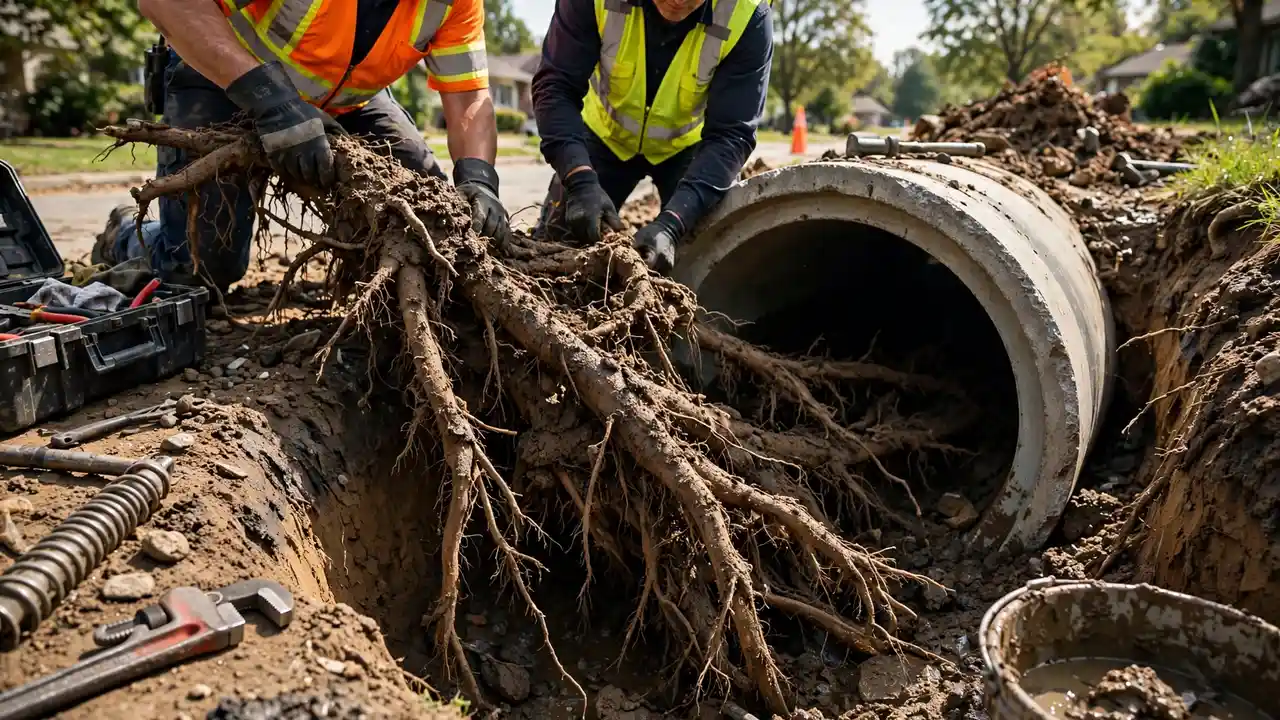
In short: If there is one cause of sewer trouble that defines Cerritos, it is tree roots. The city's mature street trees and decades-old landscaping — ficus, eucalyptus, camphor, liquidambar — have root systems that can travel remarkable distances in search of water, and a sewer lateral is a year-round oasis of moisture and nutrients. Roots do
If there is one cause of sewer trouble that defines Cerritos, it is tree roots. The city's mature street trees and decades-old landscaping — ficus, eucalyptus, camphor, liquidambar — have root systems that can travel remarkable distances in search of water, and a sewer lateral is a year-round oasis of moisture and nutrients. Roots do not break into healthy, watertight pipe; they exploit the tiny openings that age creates in joints and cracks, then grow into the flow until the line chokes.
Root intrusion is also one of the most misunderstood sewer problems. Cutting the roots clears the symptom but not the cause — the openings remain, and the roots return, often thicker than before. Lasting relief means dealing with the entry points, not just the roots. This guide explains how roots get in, which trees cause the most trouble in Southern California, how to recognize the signs, and the range of fixes from periodic cutting to permanent rehabilitation. When roots are suspected, a camera inspection shows exactly where they enter and how extensive the intrusion is.
Why roots target sewer lines
Roots grow toward moisture, and they are extraordinarily sensitive to it — fine root hairs can detect the water vapor escaping through a hairline crack or a slightly offset joint. A sewer lateral leaks tiny amounts of vapor at every imperfect joint, and in Southern California's long dry season, that vapor is a beacon. Once a root hair penetrates, the nutrient-rich flow inside acts as fertilizer, and growth accelerates dramatically.
What starts as a few hairlike strands becomes a dense mat over several growing seasons. The mat traps toilet paper, grease, and solids, and the blockage builds from there. Clay tile laterals with their many joints are the most vulnerable, followed by cast iron at its hub joints; even ABS and PVC can be entered at poorly made joints or transition couplings. The pipe material sets the odds, but any opening is an invitation.
The worst offenders in Southern California
Not all trees are equal threats. Ficus — especially Indian laurel fig, planted widely as a street and landscape tree — has famously aggressive, water-seeking roots and tops nearly every plumber's list of sewer invaders. Eucalyptus, with its enormous water demand and far-reaching roots, is a close second. Camphor, liquidambar (sweetgum), and jacaranda all have vigorous root systems capable of reaching laterals from surprising distances.
Palms, common across Cerritos, are less aggressive toward sewers — their fibrous root balls tend to stay compact — though no tree directly over a lateral is entirely innocent. Distance helps but does not guarantee safety: roots routinely travel well beyond the canopy's drip line. If you are planting new trees, choosing less aggressive species and keeping them away from the lateral's path is root control that costs nothing at all.
Signs of root intrusion
Root blockages have a seasonal personality. Backups or slow drains that appear every spring and early summer, then ease off, are the classic signature — that is the growing season at work. Gurgling toilets, water backing up in a tub when the washer drains, and a lateral that needs clearing on a predictable annual cycle all point to roots rather than grease or scale.
The camera tells the rest of the story: pale, hairlike masses at joints that thicken into rope-like intrusions downstream. Footage also reveals whether roots are the whole problem or just the most visible one — heavy root intrusion often accompanies offset joints or cracked sections that need structural attention, not just cutting. That distinction is why professional root removal should always pair cutting with a camera assessment of the entry points.
Removal options — and why cutting alone is not enough
Mechanical cutting with a root-rated auger head shears the intrusion back to the pipe wall and restores flow quickly; hydro jetting follows up by scouring the remaining debris and smaller root hairs from the pipe interior. Both are effective clearances, and for a line that is otherwise sound, periodic cutting on a maintenance schedule can manage the problem for years.
But cutting is pruning, and pruning stimulates growth — roots typically return thicker within a season or two, and each cutting cycle risks enlarging the openings they came through. Foaming root treatments applied after cutting can slow regrowth by killing roots on contact inside the pipe without harming the tree. For a permanent answer, the entry points themselves must be eliminated: lining the affected section seals every joint and crack under a continuous new pipe wall, and roots cannot penetrate cured epoxy.
Living with trees and sewers together
You do not have to choose between your trees and your plumbing. Start by knowing where your lateral runs — a camera inspection maps it — and avoid planting aggressive species within that corridor. Root barriers, vertical panels buried between trees and the pipe trench, can deflect growth downward and away, though installing them before roots arrive gives far better results than installing them after.
For existing conflicts, match the response to the footage. Light intrusion at one or two joints may justify scheduled cutting plus root treatment. Heavy intrusion across many joints, or roots entering through structural cracks, argues for lining or replacing the affected run — after which the trees can stay exactly where they are. The goal is not a root-free yard; it is a sewer the roots cannot enter.
Frequently Asked Questions
Will cutting tree roots damage my sewer pipe?
Proper root cutting with the right auger head clears roots without harming sound pipe. The risk is to already-fragile pipe — heavily scaled cast iron or deformed Orangeburg can be damaged by aggressive cutting, which is why a camera inspection should come first to confirm the pipe can take it.
Do chemical root killers work?
Copper sulfate and foaming herbicides can kill roots inside the pipe and slow regrowth, but they do not remove the existing blockage and they do nothing about the openings the roots came through. They work best as a follow-up after mechanical cutting, not as a standalone fix.
Can roots break a solid PVC pipe?
Roots do not break into intact, well-joined PVC — they enter through openings: poorly solvent-welded joints, cracked sections, or transition couplings to older pipe. If roots are in a PVC lateral, the camera will show exactly which joint or defect let them in, and that defect is what needs repair.
Should I remove the tree to save the sewer?
Rarely necessary. Removing the tree does not close the openings in the pipe — roots from neighboring trees or regrowth can still enter. Sealing the entry points with lining or replacing the defective section solves the problem while the tree stays.
How often do roots need to be cut?
It varies by tree species, pipe condition, and season — many Cerritos homeowners with ficus or eucalyptus near clay laterals end up on an annual cycle. If you are cutting more than once a year, the economics usually favor a permanent fix like lining over perpetual cutting.
Related reading
Sewer Line Problems Don’t Wait. Neither Should You.
Call now and reach a local sewer line specialist serving Cerritos, CA and nearby northwest suburbs — 24/7.
(833) 713-2101Free to call · No obligation · 24/7 emergency line