
Pipe Bursting in Cerritos, CA
Pipe bursting replaces a failed Cerritos, CA sewer lateral by fracturing the old pipe underground and pulling a seamless HDPE pipe through the same path — two small pits, no open trench across the yard. Call (833) 713-2101.
- 24/7 emergency line
- Southeast LA County specialists
- Free to call
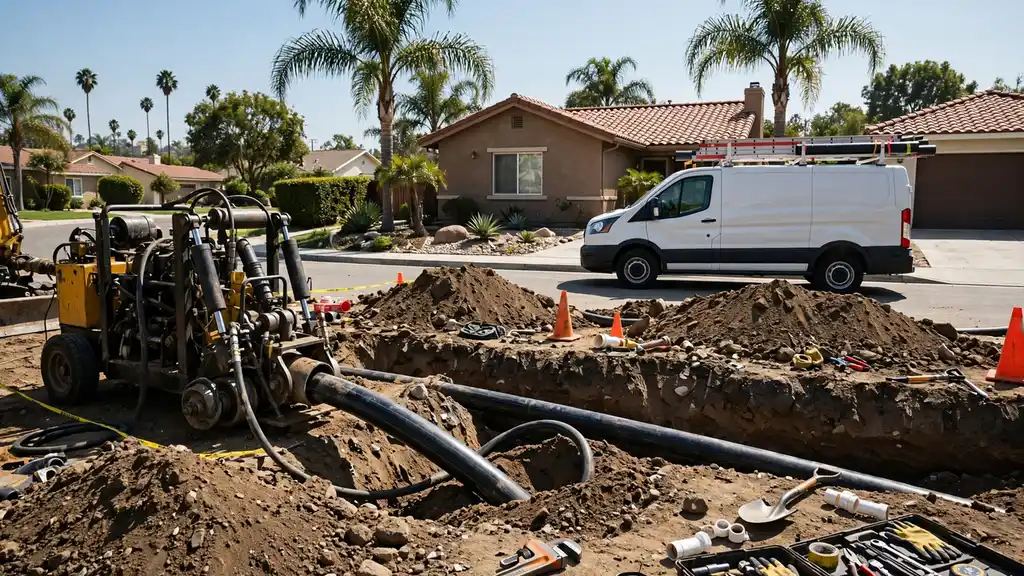
In short: Pipe bursting in Cerritos, CA breaks apart the old sewer line underground while a new joint-free HDPE pipe takes its place in the same alignment — usually in one day, without trenching the driveway, patio, or landscaping. Call (833) 713-2101 for a camera inspection to confirm your lateral is a bursting candidate.
Some laterals are past what lining can save — caved-in stretches, joints knocked far out of line, pipe that no longer holds its round. Pipe bursting replaces those lines without opening a trench the length of the yard. A hardened bursting head travels the old pipe, shattering clay tile, cast iron, or Orangeburg outward into the soil, while a new high-density polyethylene (HDPE) pipe trails right behind it into the same channel.
The method suits Southern California ground. The LA basin's alluvial sandy loam displaces readily around the bursting head, and the long laterals typical of tract homes — running beneath driveways, walkways, and established landscaping — burst cleanly where open-cut excavation would tear up the whole front yard. Two small pits, one at each end of the run, are the only digging the property sees.
What comes out of the pull is a single continuous pipe: heat-fused HDPE with no joints for roots to enter and no seams for soil to work into. Most residential bursts finish in one day, with the home's drains back in service the same evening. Call (833) 713-2101 — the first step is always a camera inspection to confirm the line can guide a bursting head.
Signs You Need Pipe Bursting
Camera shows collapsed or missing sections
When inspection reveals the old pipe has caved in or sections are gone entirely, a liner has nothing to bond to. Bursting replaces the full run, using the old alignment as its guide.
Severely offset joints along the run
Joints shifted inches apart by seismic movement or soil settlement mean the pipe's alignment is lost. Bursting installs one continuous new pipe with no joints left to shift.
Orangeburg pipe past its lifespan
The tar-impregnated fiber pipe of the postwar building boom deforms, blisters, and collapses with age. Bursting is the standard replacement for it wherever it still serves older homes.
Roots returning within months of every cutting
If root masses grow back a few months after each cutting, the joints are too far gone to save. A seamless HDPE replacement removes every entry point in a single pull.
Bellies holding standing water
Sagging sections where waste collects and the camera sits in pooled water cannot be lined flat. Bursting re-establishes proper grade with the new pipe following the intended slope.
Clay tile at 60-plus years under ficus canopy
The original laterals of Lakewood, Downey, and Long Beach tracts — 1950s-70s clay tile beneath decades of ficus root growth — are textbook bursting candidates once roots have won the joints.
What Causes Pipe Bursting Problems
Pipes reach the bursting stage through the slow arithmetic of age, soil, and movement. Clay tile joints separate a fraction of an inch at a time as seismic micro-movement works them and as the sandy loam swells and shrinks through wet winters and dry summers. Cast iron corrodes from the inside until the bottom of the pipe disappears. Orangeburg, never meant to last sixty years, ovals and blisters until it gives way. Ficus roots exploit every opening, wedging joints wider year after year.
Bursting fits when the failure is structural and spread out — not a single bad coupling but pipe material that has given up along the run. The camera survey settles it: the footage shows whether the old line can still steer a bursting head, or whether the damage pattern points to a different method.
How Pipe Bursting Works, Step by Step
- 1Camera inspection and utility locate
Call (833) 713-2101. The technician cameras the full lateral, maps its depth and path, confirms bursting is viable, and marks underground utilities before any digging begins.
- 2Two small access pits
An entry pit and an exit pit are excavated at the ends of the run — typically a few feet square each. Everything between them stays untouched: driveway, patio, and planting beds remain in place.
- 3Bursting head and new pipe staged
A hardened steel bursting head goes onto a winch cable or hydraulic puller, with the new HDPE — fused into one joint-free length — hitched behind it.
- 4The pull
The head fractures the old pipe outward into the surrounding soil while the new HDPE pipe slides into the exact same alignment. The crew monitors depth, line, and pull force throughout.
- 5Connections, backfill, and verification
The new pipe is connected at the house and at the main, the pits are backfilled and compacted in lifts, and a final camera pass verifies the installation before the surface is restored and drains are tested.
Equipment and Materials
- Hydraulic or winch-powered pipe bursting rig
- Hardened steel bursting heads sized to the old pipe
- HDPE pipe with heat-fused seamless joints
- Sewer camera with sonde locator for pre-mapping
- Compact excavation equipment for the access pits
- Compaction equipment for pit backfill
Safety on Every Visit
Bursting runs heavy equipment under tight control: pits get shored or sloped so walls can't cave, buried utilities are found and marked before the first pull, the pull lane stays clear of people and pets, and hydraulic pressure is watched the whole time. Before any backfill, a closing camera run confirms the new pipe's connections.
Pipe Bursting in Cerritos's Northwest Suburbs
Local conditions favor bursting across the trade area. The long tract laterals of Lakewood, Downey, and Cerritos run beneath driveways that are costly to cut and replace — bursting threads the new pipe underneath them. Hillside laterals in Signal Hill and Whittier, where open excavation on a slope risks soil movement, burst through two small pits instead. Mature ficus corridors in Fullerton, Anaheim, and Cypress have destroyed more clay tile joints than any other single cause, and the basin's sandy loam displaces cleanly around the head. The pre-pull camera inspection confirms the soil and depth conditions typical of the area before anything is staged.
Related Sewer Services
Frequently Asked Questions
How much digging does pipe bursting require?
Two small access pits — one at each end of the run, typically a few feet square. There is no continuous trench, so the driveway, patio, walkways, and planting beds between the pits stay in place.
What kind of new pipe is installed?
High-density polyethylene (HDPE), heat-fused into one continuous length with no joints. It resists root intrusion, internal corrosion, and ground movement, and it is the standard replacement pipe for bursting work.
Can bursting handle collapsed sections?
Half-collapsed, badly mangled pipe is bursting's home turf — the head smashes the old material aside as it advances. A run that has flattened completely with no channel left may need a short open-cut lead-in first, and the camera survey will show that before work starts.
How long does a residential burst take?
Most Cerritos-area residential laterals burst in one day, with drains back in service the same evening. Longer runs or commercial lines can extend into a second day.
Will bursting disturb my slab foundation or the street?
The bursting head displaces soil only in the immediate zone around the old pipe's path. Entry and exit pits are positioned to keep the pull clear of the foundation and street infrastructure, and depth and nearby utilities are mapped before the pull starts.
When is bursting chosen over pipe lining?
When the old pipe has lost its shape — collapses, severe offsets, heavy deformation — a liner has nothing sound to bond to, and bursting becomes the trenchless answer. When the pipe barrel is intact and only the joints have failed, lining is usually the lighter fix. The camera inspection is what decides between them.
Sewer Line Problems Don’t Wait. Neither Should You.
Call now and reach a local sewer line specialist serving Cerritos, CA and nearby northwest suburbs — 24/7.
(833) 713-2101Free to call · No obligation · 24/7 emergency line