
Commercial Sewer Services in Cerritos, CA
Restaurants, retail centers, office buildings, and industrial sites across Cerritos, CA get commercial sewer service planned around business hours — camera inspection, hydro jetting, grease-line care, and trenchless repair, day and night. Call (833) 713-2101.
- 24/7 emergency line
- Southeast LA County specialists
- Free to call
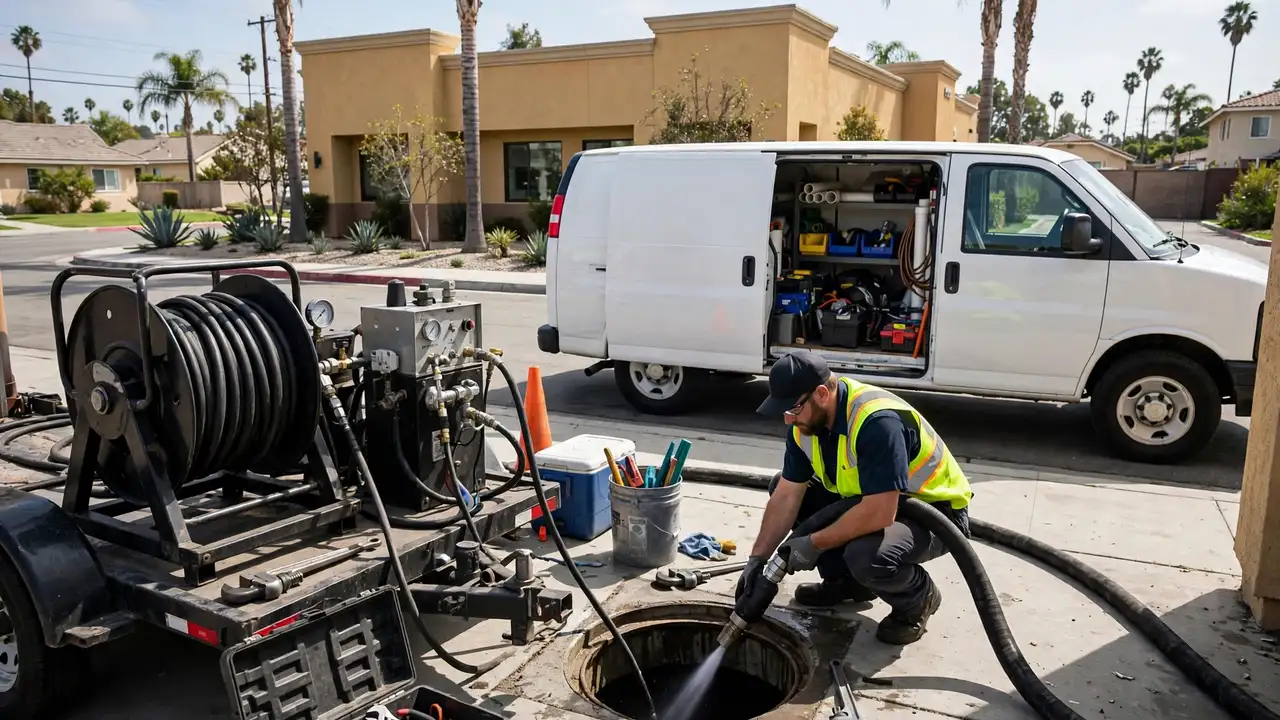
In short: Commercial sewer service in Cerritos, CA covers camera inspection, hydro jetting, grease-line clearing, and lateral repair or replacement for businesses across the LA basin and north Orange County. Call (833) 713-2101 with the property type and the symptoms, and Sewer Line Repair Solutions will plan the work around your operating schedule.
A commercial sewer lateral carries a different workload than a residential one. Kitchen grease from a restaurant line, restroom volume from an office floor, food solids from a grocery prep area, and the daily flush count of a retail center all move through the same pipe — and in the slab-on-grade commercial buildings common across Southern California, there is no basement buffer when that pipe slows. A backup surfaces at the lowest fixture or the nearest floor drain, right where customers and employees are.
That is why commercial work is scheduled and scoped differently. Jobs are planned around operating hours so dining rooms, lobbies, and sales floors stay open. Grease interceptors, shared laterals, and tenant tie-ins are mapped before equipment arrives, and every visit is documented so property managers can file it with maintenance records. One call to (833) 713-2101 connects you with Sewer Line Repair Solutions and a local specialist who handles the logistics.
The Cerritos area's commercial mix shapes the work: restaurants and food courts around the Los Cerritos Center and Cerritos Towne Center corridors, strip centers along South Street and Alondra Boulevard, light industrial and warehouse properties in Santa Fe Springs, Carson, and Paramount, and older retail corridors in Lakewood and Downey where 1950s-70s clay tile building sewers are still in service. Each setting fails in its own way, and the diagnosis starts with what the property does all day.
Signs You Need Commercial Sewer Services
Restroom backups during peak traffic
When toilets and floor drains back up only during lunch rushes, weekend crowds, or shift changes, the lateral is reaching capacity or grease is narrowing it. The pattern — tied to business hours rather than random — points to the shared line, not a single fixture.
Grease pushing past the interceptor
Grease surfacing around interceptor lids or showing up downstream in the lateral means the trap is full or the line beyond it is restricted. For food businesses this is a sanitation risk that needs attention before the next health inspection, not after.
Sewer odor in dining areas or lobbies
Sewer gas where customers sit or walk usually means a dry trap, a compromised vent, or a lateral defect letting gas escape. In air-conditioned commercial buildings the smell recirculates, so it gets noticed fast.
Several fixtures slowing at once
When sinks, toilets, and floor drains across a suite or a kitchen all slow together, the restriction is in the shared building sewer. One slow sink is a fixture problem; a whole slow restroom is a lateral problem.
Wet soil or settling pavement on the lot
Soggy patches, sinking asphalt, or depressions in the parking lot over the lateral's path suggest a leak washing the sandy loam away underground. Left alone it undermines pavement and invites a much bigger repair.
Repeat drain calls from the same tenant space
When the same unit needs clearing every few months, the cause is in the pipe — root intrusion at a joint, a bellied section holding grease, or scale narrowing old cast iron — and clearing treats the symptom while the defect waits.
What Causes Commercial Sewer Services Problems
Commercial laterals fail for commercial reasons. Kitchen grease cools and solidifies on pipe walls, narrowing the line a little more each month until a busy Friday night finishes the job. High-volume restroom use pushes paper and solids through building sewers that were sized decades ago for lighter loads. In the industrial pockets of Santa Fe Springs, Carson, and Paramount, process solids and washdown grit add abrasive load that residential pipes never see.
Age and setting do the rest. Much of the commercial stock along the Lakewood, Downey, and Long Beach corridors dates to the 1950s-70s, with clay tile or cast-iron building sewers now at the stage where joints separate and interiors corrode. Mature ficus and street trees send roots into every opening, and the region's seismic micro-movement shifts joints a fraction at a time. Add the November-March atmospheric river season, when saturated sandy loam presses groundwater into every cracked joint, and the pattern is clear: gradual slowdown, then a sudden backup at the worst possible hour.
How Commercial Sewer Services Works, Step by Step
- 1Describe the property and the symptoms
Call (833) 713-2101 with the building type, the symptoms, and when they occur. Peak-hour patterns, grease history, and tenant layout help the specialist arrive with the right equipment the first time.
- 2Camera inspection and mapping
A camera travels the full run from the building to the main, mapping grease buildup, root entry, offsets, and structural defects with exact distances — and locating interceptors, cleanouts, and shared tie-ins on the way.
- 3Clearing and hydro jetting
Pressurized water jetting strips grease, scale, and solids off the pipe walls, with pressure tuned to the pipe material so the line returns to full diameter — no excavation, and the business stays open while it happens.
- 4Targeted repair or trenchless replacement
Where the camera finds damage, the fix is surgical: sectional lining, pipe bursting, or spot repair — scheduled for early mornings, evenings, or weekends so business continues.
- 5Written findings and a maintenance plan
You receive a documented summary of what was found and what was done, plus a jetting and inspection interval matched to the property's actual usage — the file your maintenance records and lease compliance need.
Equipment and Materials
- Sewer inspection camera with locator and footage counter
- Trailer-mounted hydro jetter for grease and scale removal
- Root-cutting and descaling chain-flail heads
- Sectional CIPP lining kits for commercial pipe diameters
- Pipe bursting rigs for full lateral replacement
- Grease-interceptor pump-out scheduling and coordination
Safety on Every Visit
Commercial sewer work runs on jobsite discipline: confined-space awareness at manholes and deep cleanouts, ventilation before any entry, traffic control and barricades when the lateral crosses parking lanes or drive aisles, and powered equipment kept clear of customers and employees. Waste is contained and hauled off the property, never left on the lot, and work zones are marked so foot traffic routes around them.
Commercial Sewer Services in Cerritos's Northwest Suburbs
The Cerritos trade area writes its own commercial playbook. Restaurant rows around Los Cerritos Center and the Towne Center need grease-program discipline through the November-March storm season, when infiltration swells already-narrowed lines. Strip centers along South Street, Alondra Boulevard, and in Bellflower and Norwalk share laterals across tenant spaces, so one tenant's grease becomes everyone's backup. Light industrial in Santa Fe Springs, Carson, and Paramount runs washdown solids that call for scheduled jetting. And the older retail corridors of Lakewood, Downey, and Long Beach still run 1950s-70s clay tile building sewers under parking lots where open excavation is disruptive — camera-verified diagnosis before any quote is the standard here.
Related Sewer Services
Frequently Asked Questions
How do you schedule commercial work around our business hours?
Call (833) 713-2101 and tell the specialist your operating hours. Inspection and jetting are routinely set for early mornings, evenings, or weekends so dining rooms, lobbies, and sales floors stay open. Backup emergencies are handled the same day, around the clock.
Do you service restaurant grease lines?
Yes. Pumping out grease interceptors and clearing the grease lines beyond them is everyday commercial work. The camera shows whether grease is slipping past the trap and choking the lateral, and water jetting clears it without opening the kitchen floor or the parking lot.
Can you work on a lateral shared by multiple tenants?
Yes. Strip centers and multi-tenant buildings often share one building sewer to the main. The inspection maps which tenant tie-ins feed the problem, and repairs are coordinated through the property manager so every tenant is notified once and the disruption happens once.
Why does our property back up only on busy days?
Because the restriction is partial: the line still passes normal flow but cannot handle peak volume. Grease narrowing, a root mass, or a bellied section all create a ceiling on capacity — and the ceiling gets hit exactly when the business is busiest. A camera inspection finds which one it is.
Do we get documentation for our maintenance files?
Yes. Commercial visits come with a written summary of findings and work performed — the record property managers file with maintenance logs, lease compliance files, and, for food businesses, sanitation readiness paperwork.
How often should a restaurant's lateral be jetted?
It depends on kitchen volume and the interceptor's condition. High-volume kitchens in the area commonly schedule jetting one to four times a year. The first camera inspection measures the actual buildup rate in the specific line and sets the right interval from there.
Sewer Line Problems Don’t Wait. Neither Should You.
Call now and reach a local sewer line specialist serving Cerritos, CA and nearby northwest suburbs — 24/7.
(833) 713-2101Free to call · No obligation · 24/7 emergency line