
Sewer Leak Detection in Cerritos, CA
Sewer leak detection in Cerritos, CA pinpoints where wastewater is escaping your line — under the slab, in the yard, at a joint — before it undermines soil, draws roots, or reaches groundwater. Call (833) 713-2101.
- 24/7 emergency line
- Southeast LA County specialists
- Free to call
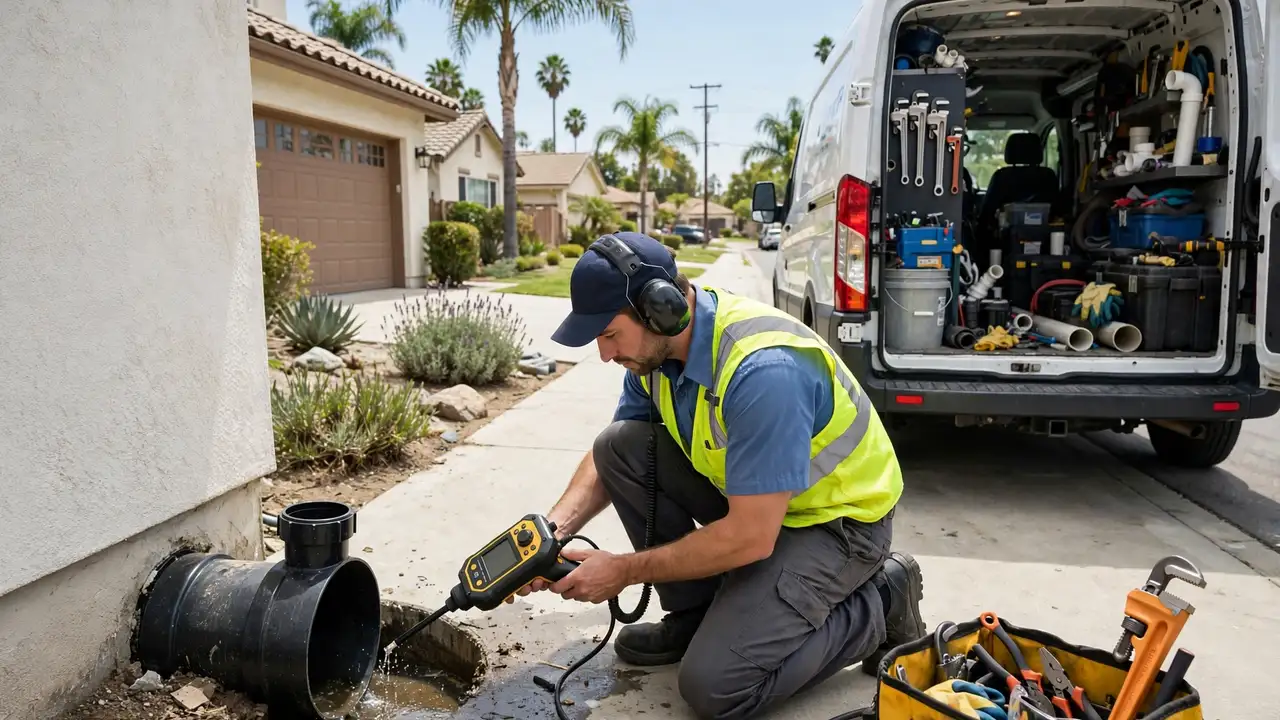
In short: Sewer leak detection in Cerritos, CA combines camera inspection, smoke and dye testing, and isolation tests to find the exact source of a sewer leak — not just its symptoms. Call (833) 713-2101 when you smell sewage, see soggy soil, or notice a suspiciously green strip across the lawn.
A leaking sewer lateral and a blocked one are different problems with different fixes. A blockage stops flow; a leak lets wastewater escape into the surrounding soil — quietly, continuously, and often invisibly. In Southern California's slab-on-grade homes the first signs are subtle: a sewage odor with no visible backup, a patch of lawn that stays green through the dry summer, damp soil along the foundation, or a walkway slab that has settled a fraction of an inch.
Finding the leak matters because an unrepaired leak does not stay a small problem. Escaping water washes the basin's sandy loam away from around the pipe, undermining driveways, walkways, and slab edges. Every leak is also a beacon for ficus roots, which grow toward moisture and widen the opening year after year. Near the coast, where the water table runs high, a leaking lateral and rising groundwater meet — and the line that leaks outward in summer takes water inward during the November-March storm season.
Leak detection is diagnostic work, not repair work: the goal is to pinpoint the source so the repair — a spot fix, a sectional lining, or a replacement — addresses the actual opening instead of the general area. Camera inspection, smoke testing, drain dye, and isolation tests each answer a different question, and the technician chooses the combination that fits what the property is showing.
Signs You Need Sewer Leak Detection
Persistent sewage odor with no visible backup
A foul smell in the yard, near the foundation, or inside the house — without any drain actually backing up — often means wastewater is escaping the pipe underground and its gases are finding their way up.
A lush green strip across the lawn
Wastewater is fertilizer. A band of grass that stays green and grows fast through the dry summer, tracing a line from the house toward the street, is the classic surface signature of a leaking lateral.
Soggy soil or settling hardscape
Soil that stays wet without irrigation, or a walkway, patio, or driveway section that has sunk slightly, suggests water escaping below and washing the sandy loam out from under the surface.
Dampness or odor along the slab edge
In slab-on-grade homes a leak beneath or beside the foundation can show as persistent dampness at the slab edge, musty odor in low rooms, or efflorescence on the foundation face.
Gurgling drains paired with a wet yard
Slow or gurgling fixtures together with soggy ground over the lateral's path point to a line that is both restricted and breached — the camera usually finds roots at the same joint that is leaking.
Depressions forming in the yard
Small sinkholes or settling spots over the pipe's path mean soil has been washing into or out of the line for some time. The longer it runs, the larger the void grows.
What Causes Sewer Leak Detection Problems
Leaks start where the pipe's defenses are weakest: the joints. In the area's 1950s-70s clay tile laterals, bell-and-spigot joints separate a fraction of an inch at a time under the basin's micro-seismic movement and the seasonal swell and shrink of sandy loam. Ficus roots follow the moisture, thread into the gap, and wedge it wider with every growth cycle. Cast iron develops its leaks differently — internal corrosion pits through the pipe wall until pinholes and then larger openings let wastewater seep out.
Storm season exposes what the dry months hide. During the November-March atmospheric rivers, saturated soil presses against every cracked joint, and a lateral that seeped outward all summer begins taking groundwater inward — the camera catches both directions of flow at the same defect. Construction damage writes its own chapter: fence posts, patio footings, and landscape grading have all crushed or punctured laterals across the tracts, and the leak that results can run for years before the surface shows it.
How Sewer Leak Detection Works, Step by Step
- 1Call and describe the signs
Call (833) 713-2101 and describe what you are seeing or smelling — where, for how long, and whether it changes with rain or water use. The pattern guides which tests come first.
- 2Camera inspection of the lateral
A camera travels the full line documenting cracks, separated joints, root entries, and breaks — the visual evidence that narrows the search before any testing begins.
- 3Smoke or dye testing
Depending on the situation, non-toxic smoke is introduced through the vent system to reveal where gases escape, or drain dye is flushed to trace where water leaves the pipe. Each test answers whether the leak is in the lateral, a branch, or a vent connection.
- 4Isolation testing of suspect sections
Test plugs isolate the section the camera flagged, and a static water test confirms whether that segment holds or loses water — turning a suspected leak into a proven one.
- 5Locate, mark, and explain the repair options
The sonde locator marks the leak's position and depth on the surface, and you get a clear explanation of the fixes that fit — spot repair, sectional lining, or replacement — with the evidence recorded.
Equipment and Materials
- Sewer inspection camera with sonde locator
- Smoke testing machine with non-toxic smoke fluid
- Drain tracing dye (non-toxic, plumbing-safe)
- Isolation test plugs and static test equipment
- Moisture meter for slab-edge and soil readings
- Acoustic listening equipment for pressurized leak confirmation
Safety on Every Visit
Detection work is non-invasive by design: no excavation happens during testing. Smoke testing uses non-toxic fluid and the crew accounts for ventilation so it does not linger indoors; drain dye is plumbing-safe and formulated to flush clear; isolation tests are low-pressure and controlled. Sanitary handling of camera equipment and clear communication about each test step keep the visit straightforward.
Sewer Leak Detection in Cerritos's Northwest Suburbs
Local ground conditions shape every leak investigation. The basin's sandy loam lets escaping water travel, so the soggy spot on the surface is often feet from the actual opening — the locator and testing close that gap. Down by the shoreline in Long Beach and Los Alamitos, groundwater sits high enough to hide a leak's surface clues completely, which is why testing beats looking there. On the Signal Hill and Whittier hillsides, a leaking lateral washes slope soil downhill, and finding it early protects the slope itself. And across the ficus-lined streets of Fullerton, Anaheim, Cypress, and Lakewood, the camera almost always finds roots already exploiting the leak — detection and root assessment arrive together.
Related Sewer Services
Frequently Asked Questions
How is leak detection different from a camera inspection?
A camera inspection shows the pipe's condition; leak detection proves where wastewater is escaping. The camera is always the first step, but smoke testing, dye tracing, and isolation tests answer the question the camera alone cannot: is this crack actually leaking, and how much?
What is smoke testing, and is it safe?
Non-toxic smoke is introduced into the vent system and watched for where it escapes — through a cracked joint, a broken vent, or a faulty connection. The fluid is formulated for this purpose and the crew manages ventilation so it clears quickly. It is one of the fastest ways to find a leak's exit point.
Can you find a leak under my concrete slab?
In many cases, yes. The camera travels beneath the slab through the line itself, and the locator reads its position from above. Moisture meters check the slab edge, and isolation testing can prove which section loses water — all without breaking concrete to look.
Why is one strip of my lawn greener than the rest?
Because wastewater is fertilizer. A green band tracing the lateral's path from house to street is the most common surface sign of a leak — the grass is being fed from below. Detection confirms which joint or section is feeding it.
Will a small leak get worse if I wait?
Almost always. Escaping water keeps washing sandy loam away from the pipe, roots keep widening the opening, and the void underground keeps growing. A joint that seeps today becomes the sinkhole, the undermined walkway, or the storm-season infiltration point of next year.
What happens after you find the leak?
You get the leak's exact location and depth, marked on the surface, with the recorded evidence. From there the fix follows the finding: a spot repair for a single failed joint, sectional lining for a damaged run, or bursting for a line whose material has failed — each matched to what the testing proved.
Sewer Line Problems Don’t Wait. Neither Should You.
Call now and reach a local sewer line specialist serving Cerritos, CA and nearby northwest suburbs — 24/7.
(833) 713-2101Free to call · No obligation · 24/7 emergency line