
Pipe Lining in Cerritos, CA
Pipe lining (CIPP) builds a new pipe inside your old Cerritos, CA sewer line — an epoxy liner cured hard, smooth, and joint-free, with no trench across the property. A camera inspection first confirms your line qualifies. Call (833) 713-2101.
- 24/7 emergency line
- Southeast LA County specialists
- Free to call
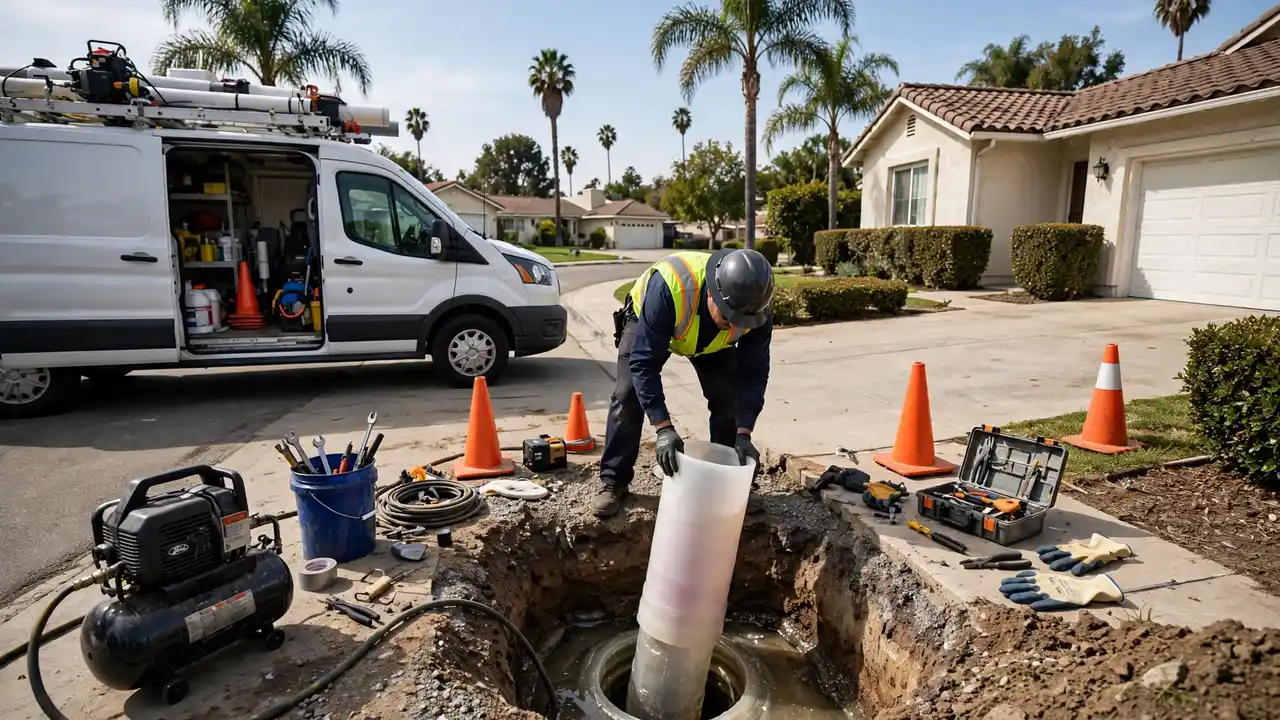
In short: Pipe lining in Cerritos, CA installs a resin-saturated liner inside the existing sewer pipe that cures into a smooth, jointless new pipe within the old one — often completed in one day with no digging. Call (833) 713-2101 to schedule the camera inspection that determines whether lining fits your line.
Of all the ways to renew a failing lateral, cured-in-place pipe (CIPP) lining disturbs the property least. The old pipe stays in the ground: a flexible epoxy-soaked liner is inverted or drawn inside it, pressed hard against the interior wall, and cured into a rigid, glassy-smooth tube with no joints. Clay tile or cast iron becomes the shell; the liner becomes the working pipe — and nothing above grade is disturbed.
Across Cerritos and the surrounding cities, lining fits the most common failure pattern: a pipe barrel that is still structurally sound with joints that have failed. Ficus roots enter at the couplings, seismic micro-movement separates them a fraction at a time, and winter groundwater seeps in through every gap — while the clay tile or cast iron between the joints remains solid. One bad joint after another, sealed from the inside in a single day, with patios, pool decks, and mature landscaping untouched.
Not every line qualifies, and that is exactly what the pre-lining camera inspection establishes. Call (833) 713-2101 and the technician will show you, on the monitor, whether your lateral is a lining candidate or whether the damage pattern calls for bursting or repair instead.
Signs You Need Pipe Lining
Root intrusion at the joints, barrel still sound
When the camera shows roots entering at couplings while the pipe between them holds its shape, lining seals every joint in one pass — the highest-value fix for this pattern.
Cracks and fractures that hold their shape
Longitudinal cracks and fractured sections that have not collapsed are ideal: the liner bridges them and restores a continuous structural wall.
Scale and corrosion narrowing cast iron
Older cast-iron house sewers lose diameter to internal scale and tuberculation. After descaling, a liner gives the pipe a smooth new interior and full flow.
Slightly offset joints admitting water and soil
Joints shifted just enough to let groundwater and fine sandy soil seep in are a classic lining fix — the cured liner spans the offsets and stops the infiltration.
Blockages returning to the same footage marks
When every clearing finds the snag at the same distance from the cleanout, the defect is fixed in place and the liner eliminates it rather than clearing its symptom again.
A patio, pool deck, or mature trees over the line
When the lateral runs beneath hardscaping, a pool deck, or decades-old landscaping, lining avoids the excavation that open-cut replacement would demand — the surface never opens.
What Causes Pipe Lining Problems
Lining candidates are created by joint failure rather than material failure. Clay tile pipe from the 1950s-70s tracts is still strong in the barrel, but its joints — bell-and-spigot or banded couplings — separate under the basin's constant micro-seismic movement and through the seasonal swell and shrink of sandy loam between wet winters and dry summers. Each separated joint is a doorway: ficus roots thread in during the dry months, groundwater pushes in during the November-March storm season.
Cast iron fails from the inside out instead. Internal corrosion roughens the pipe wall until waste snags and builds, and the rough surface gives roots and scale fresh purchase. What lining cannot fix is loss of shape — a fully collapsed section, a severe belly holding inches of standing water, or pipe crushed by heavy surface loads. Drawing that line is the entire purpose of the pre-lining camera inspection.
How Pipe Lining Works, Step by Step
- 1Camera inspection and cleaning
Call (833) 713-2101. The line is camera-mapped end to end, then hydro-jetted or mechanically descaled so the liner bonds to a clean, sound surface.
- 2Liner measurement and wet-out
The liner is cut to the exact footage of the run and saturated with two-part epoxy resin, then loaded for inversion or pull-in through the existing access.
- 3Installation
The liner is inverted into the old pipe with air or water pressure, pressing it firmly against the host pipe's interior from one end of the run to the other.
- 4Curing
Hot water, steam, or ambient curing hardens the resin into a rigid, jointless new pipe — typically within a few hours — while the crew monitors temperature and pressure.
- 5Final camera verification
A post-cure camera pass confirms full adhesion to the host pipe, open branch tie-ins, and smooth flow before the crew restores the access points and tests the drains.
Equipment and Materials
- CIPP liner tubes in residential and commercial diameters
- Two-part epoxy resin systems
- Inversion drums or pull-in winches
- Curing equipment (hot water, steam, or ambient)
- Hydro jetters and descaling chain flails for surface prep
- Pre- and post-installation sewer cameras
Safety on Every Visit
Lining is low-excavation work with serious chemical handling: resins are mixed and handled with gloves and ventilation per the manufacturer's data, curing pressures and temperatures are monitored continuously, access points are barricaded, and the crew confirms every branch tie-in is open before the liner cures. The work area stays clean — no trench, no spoil piles, no open pipe.
Pipe Lining in Cerritos's Northwest Suburbs
The Cerritos trade area is lining country. The 1950s-70s clay tile tracts of Lakewood, Downey, and Long Beach present the textbook profile — sound barrels, failed joints, ficus roots at every coupling — and their established front yards, patios, and pool decks make no-dig renewal the natural choice. Older cast-iron stock in Long Beach, Compton, and Carson lines up for descaling plus lining. Laterals on the Signal Hill and Whittier slopes, where digging openly risks shifting soil, are excellent lining prospects whenever the pipe barrel is still sound. And the November-March storm season is what usually reveals the infiltration that lining is designed to stop.
Related Sewer Services
Frequently Asked Questions
How long does a lined pipe last?
A properly installed CIPP liner is engineered for a 50-year design life. With no joints for roots to enter and a smooth epoxy surface that resists scale and corrosion, it outlasts the conditions that damaged the original pipe.
Does lining reduce the pipe's diameter?
Only slightly — the liner wall is a few millimeters thick. Because the cured surface is far smoother than old clay tile or scaled cast iron, flow capacity typically improves despite the small reduction.
Can every sewer line be lined?
No. The existing pipe has to keep its round: no total collapses, no deep bellies, and enough diameter all the way through. The camera survey before lining is what passes or fails a candidate — call (833) 713-2101 to book it.
How long does a lining job take?
Most residential linings complete in one day: morning camera work and preparation, liner installation around midday, afternoon cure, and a final camera verification before evening.
Can we stay home during the lining?
Usually, yes. Water use is paused for a few hours during the cure, and the crew will tell you the exact window in advance. There is no trench, no heavy equipment in the yard, and no reason to leave the house.
How do you choose between lining and pipe bursting?
It comes down to the pipe's shape. If the barrel is intact and only the joints have failed, lining renews the line from the inside. If sections have collapsed or the pipe is badly deformed, bursting replaces the whole run. The camera inspection shows which situation you have, and the recommendation follows from what it reveals.
Sewer Line Problems Don’t Wait. Neither Should You.
Call now and reach a local sewer line specialist serving Cerritos, CA and nearby northwest suburbs — 24/7.
(833) 713-2101Free to call · No obligation · 24/7 emergency line