
Sewer Line Repair vs. Replacement: A Decision Framework
Repair fixes the bad section; replacement renews the whole line. Here is how to read your camera footage, weigh the options, and choose with confidence.
In short: Every failing sewer line eventually forces the same question: repair the damaged section, or replace the whole lateral? The answer matters more than most home decisions because the work is disruptive, the pipe is buried, and choosing wrong means paying twice — once for the fix that did not hold, and again for the one
Every failing sewer line eventually forces the same question: repair the damaged section, or replace the whole lateral? The answer matters more than most home decisions because the work is disruptive, the pipe is buried, and choosing wrong means paying twice — once for the fix that did not hold, and again for the one that should have been done first.
There is no universal right answer, but there is a reliable way to reach the right one for your house. It starts with camera footage, runs through the pipe's material and overall condition, weighs how often the line has needed help, and factors in trenchless options that did not exist a generation ago. This guide lays out that decision framework for Cerritos homes — slab foundations, mid-century clay and cast iron, LA basin soils — so that when a technician presents options, you can evaluate them rather than just react. If you are facing the decision now, a camera inspection at (833) 713-2101 is the step that makes everything else clearer.
Start with what the camera shows
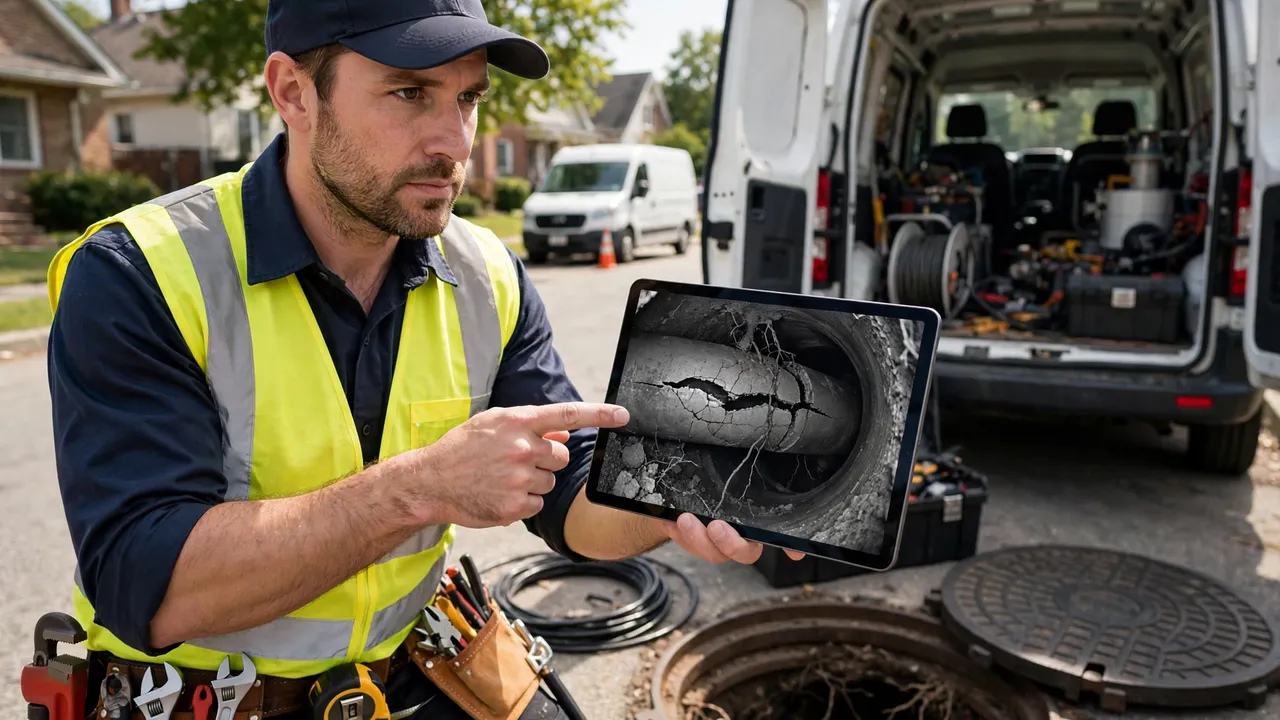
No decision about a buried pipe should be made without seeing it, and that makes the camera inspection the non-negotiable first step. The footage answers the questions everything else depends on: Where exactly is the damage, and how far does it extend? Is the pipe round and continuous apart from the bad spot, or is it deteriorated along its whole length? Are the joints intact, or are roots entering at a dozen of them? A ten-foot cracked section in an otherwise sound line and a sixty-foot line with failing joints every few feet are different problems that happen to share symptoms.
Watch the footage with the technician and ask for the findings in plain terms: how many defects, of what type, at what distances. A single offset joint under the lawn is a repair candidate; widespread channeling along the bottom of a cast-iron run, or clay tile with root intrusion at most joints, describes a line whose problems are systemic rather than local. That distinction — local versus systemic — is the hinge the whole repair-or-replace decision swings on.
When a repair is the sensible call
Repair wins when the damage is local and the rest of the line has life left. The classic cases: one cracked section of clay tile where a root mat keeps forming, a single separated joint after soil movement, a short stretch of cast iron with a hole while the surrounding pipe still shows full wall thickness on camera. In these situations a sectional repair — excavating just the bad segment, or lining just that section trenchlessly — solves the actual problem without disturbing the sound pipe around it.
Repair also makes sense as a staged strategy. A homeowner planning a larger remodel in a few years, or weighing a future full-length lining, might reasonably choose a sectional fix now to buy quiet years while planning the bigger project. The key discipline is honesty about the rest of the line: a sectional repair on a pipe the camera shows is failing everywhere is not a strategy, it is a delay. Get the footage, count the defects, and make sure the repair addresses the pipe you have, not the pipe you wish you had.
When replacement makes more sense
Replacement earns its keep when the problems are systemic. A clay tile lateral with root intrusion at most joints will not be fixed by cutting roots at two of them — the remaining joints are the same age, in the same soil, under the same trees. A cast-iron line with heavy scale, channeling, and multiple holes is telling you its service life is spent. And a line that has needed emergency cleaning twice in one year is already costing the disruption and risk of failure that replacement is meant to prevent.
Site realities can also tip the decision. In Cerritos tracts where the lateral runs under a new driveway, a pool deck, or an established landscape, the disruption math favors doing the work once: a full sewer line replacement with a new pipe on proper bedding and correct slope, rather than a series of sectional repairs that each tear up the yard again. The same logic applies under slabs — opening concrete twice costs more in every sense than opening it once for a complete renewal. When the camera shows systemic failure, replacement is not the expensive option; it is the option that ends the spending.
Trenchless options that change the math
A generation ago, replacement meant an open trench from the house to the street, which made the repair-versus-replace decision heavily about disruption. Trenchless methods changed that calculation. Pipe lining creates a new pipe inside the old one through small access points, and it suits lines that are structurally continuous but deteriorated — scaled cast iron, clay tile with joint problems but no collapses. Pipe bursting pulls a new pipe through the old line's path, fragmenting the old pipe outward, and it handles lines too damaged to line, including collapsed sections.
These methods do not make the decision for you, but they widen the replacement side of the scale: a full renewal without tearing up the driveway, the patio, or the ficus the whole street admires. They have limits — lining needs a host pipe with enough integrity to hold the liner, bursting needs room for the equipment and a path free of unmapped utilities — and the camera footage plus a site assessment determine eligibility. When comparing bids, compare trenchless against trenchless and open-cut against open-cut; mixing the two in one decision muddies what is actually being weighed.
A decision checklist to use with your technician
Bring this checklist to the conversation and the decision largely makes itself. One: do I have complete camera footage with distances, and have I watched it? Two: are the defects local — countable on one hand — or systemic along the run? Three: what is the pipe's material and approximate age, and what does that imply about the sections that look fine today? Four: how many times has this line needed service in the last two years, and what did each visit find? Five: does the property layout — slab, driveway, mature landscaping — punish repeated excavations?
If the answers point to local damage in a line with life left, get the sectional repair or the targeted lining, and put the line on a camera-check cycle afterward. If they point to systemic deterioration, get the full renewal — trenchless where the pipe and site qualify — and be done with the problem for the long term. Either way, keep the footage, the written findings, and the as-built documentation with your home records; the next owner, and your future self, will be glad they exist. For an honest read of your footage and options, call (833) 713-2101.
Frequently Asked Questions
Can a sewer line be repaired in sections instead of replaced?
Yes, when the damage is local. A single cracked section, one separated joint, or a short damaged stretch can be excavated and replaced, or lined trenchlessly, while the sound pipe around it stays in place. Sectional repair stops making sense when defects are spread along the whole run.
How do I know if my line qualifies for trenchless repair?
The camera footage decides: lining needs a host pipe continuous enough to hold the liner, so collapsed or severely deformed sections rule it out; bursting needs equipment access and a clear path. A site assessment confirms utilities and space. Most aging-but-intact clay and cast-iron lines qualify for one or the other.
Will a repair last as long as a full replacement?
A well-executed sectional repair on a line that is otherwise sound can last as long as the surrounding pipe does — the repair is not the weak point. But a repair cannot extend the life of the unrepaired sections; if those are near the end of their service life, replacement is the longer-lasting answer.
Should I replace the line if I am planning a driveway or patio project?
Strongly consider it. If the lateral runs beneath the planned work and the pipe is aging, renewing the line before the concrete goes in avoids tearing up new work later. Coordinating the two projects is a practical move that avoids tearing up new work later.
Does a past repair affect a future sale of the home?
Documented professional work generally helps: buyers and inspectors like seeing camera footage, permits, and as-built records for sewer work. Undocumented or unpermitted repairs raise questions. Keep every record with your home files and disclose the work as required.
Sewer Line Problems Don’t Wait. Neither Should You.
Call now and reach a local sewer line specialist serving Cerritos, CA and nearby northwest suburbs — 24/7.
(833) 713-2101Free to call · No obligation · 24/7 emergency line