
Trenchless vs. Traditional Sewer Repair
Both methods replace your sewer line — they just get there differently. A fair comparison of trenchless and open-cut excavation for Cerritos homes.
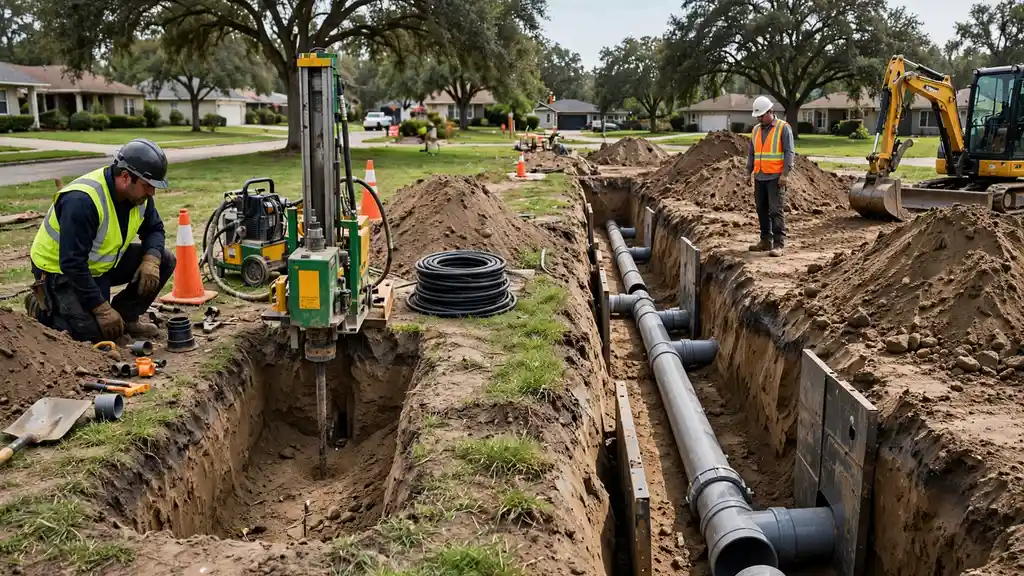
In short: When a sewer lateral needs more than cleaning, homeowners face a fork in the road: trenchless repair, which renews the pipe with minimal digging, or traditional open-cut excavation, which digs a trench along the pipe's path and lays new pipe in the open. Both are legitimate, time-tested approaches. Both produce a new, long-lived sewer line
When a sewer lateral needs more than cleaning, homeowners face a fork in the road: trenchless repair, which renews the pipe with minimal digging, or traditional open-cut excavation, which digs a trench along the pipe's path and lays new pipe in the open. Both are legitimate, time-tested approaches. Both produce a new, long-lived sewer line when done correctly. The right choice depends on your pipe's condition, your property's layout, and what the camera footage shows — not on which method a contractor happens to sell.
This guide compares the two approaches fairly: how each one works, what each one disrupts, where each one has the advantage, and how to make the decision with confidence. If you are weighing options now, start with a camera inspection — the footage is the common ground every honest comparison stands on.
How trenchless repair works
Trenchless covers two main techniques. In cured-in-place pipe lining, technicians clean the old pipe, then insert a flexible liner saturated with epoxy resin, inflate it against the pipe walls, and cure it into a smooth, jointless new pipe inside the old one. In pipe bursting, a bursting head is pulled through the old line, fracturing it outward while trailing a brand-new pipe into the same path. Both need only small access pits rather than a continuous trench.
The appeal is obvious for Cerritos properties: the driveway stays intact, the landscaping survives, the patio does not become a construction zone. Most trenchless jobs finish with the yard looking much as it did that morning. The new pipe — whether a cured liner or a pulled replacement — is jointless or fused, which removes the seams where roots entered the old line.
How traditional excavation works
Traditional repair is straightforward: excavate along the pipe's path, remove the failed pipe, lay new pipe on a properly compacted bed with correct slope, backfill, and restore the surface. There is nothing experimental about it — it is how sewers have been built for a century, and it gives the crew full visual access to everything underground: the pipe, the bedding, adjacent utilities, and the soil itself.
The tradeoff is disruption. A trench across the yard, driveway, or patio means demolition and restoration of whatever sits above the pipe — concrete, pavers, planting beds. On a slab-foundation home where the problem extends under the house, excavation can mean cutting through the slab itself. Restoration is part of the project scope and should be itemized in writing, because the digging is only half the job.
Where trenchless has the advantage
Trenchless wins wherever the surface is expensive to disturb: driveways, mature landscaping, patios, pool decks, and room additions built over the lateral's path. It also wins on speed of surface restoration — with no trench to backfill and compact, the property is usable sooner. For pipes that are structurally compromised but still substantially intact — cracked clay, scaled cast iron, root-invaded joints — trenchless rehabilitation addresses the full run in one continuous operation.
There is a durability point worth making plainly: a properly installed liner or burst replacement is not a patch or a shortcut. Cured epoxy liners and fused plastic pipe are engineered materials with long expected service lives, and the jointless result actually improves on the original segmented pipe where root entry is concerned.
Where traditional excavation has the advantage
Excavation wins wherever the camera shows conditions trenchless cannot handle: fully collapsed sections, severe bellies or backfall that need regrading, and pipe so deteriorated there is nothing left to line or burst through. It is also the right call when the problem is localized — a single bad joint or one cracked section under an accessible planting bed is often simpler to spot-dig than to mobilize trenchless equipment for.
Full visibility is excavation's quiet strength. The crew sees the bedding, corrects the slope, compacts properly, and verifies every joint — eliminating the workmanship variables that cause premature failures. When the diagnosis is uncertain or the ground is crowded with other utilities, many experienced contractors prefer the method where they can see what they are doing. Pipe bursting sits between the two worlds, but even it needs a viable path through the old pipe.
Making the decision
The decision sequence is simple, and you should insist on it: camera inspection first, with footage you keep; a written diagnosis naming each defect and its location; then a method recommendation tied to specific footage. 'Your pipe qualifies for trenchless because the run is continuous with moderate root intrusion at the joints' is a diagnosis. 'We recommend trenchless' without reference to the footage is a sales pitch.
Get the scope in writing either way: what is being replaced or rehabilitated, from where to where, what surface restoration is included, and what happens if conditions underground differ from the camera's view. The method matters less than the match between the method and the pipe — and that match is visible on the screen before anyone picks up a shovel. Questions about your options? Call (833) 713-2101 and ask for an inspection with footage you can review yourself.
Frequently Asked Questions
Is trenchless sewer repair as durable as traditional replacement?
When the pipe qualifies, yes. Cured-in-place liners and pulled plastic pipe are engineered materials with long expected service lives, and the jointless result eliminates the seams where roots entered the old pipe. Durability depends on correct installation and an honest assessment that the old pipe was a suitable host.
Which method is less disruptive to my yard?
Trenchless, by a wide margin. Lining and bursting need only small access pits, so driveways, landscaping, and patios largely survive. Open-cut excavation digs the full path of the pipe and requires surface restoration afterward.
Can I choose trenchless if my pipe has collapsed?
A fully collapsed section generally rules out trenchless for that stretch — there is no channel for the equipment to follow. A common solution is a hybrid: excavate the collapsed few feet and rehabilitate the rest trenchlessly.
Does trenchless work under a driveway or patio?
That is exactly where it shines. Structures over the pipe that would be expensive to demolish and restore are the strongest argument for trenchless methods — provided the camera shows the pipe itself is a viable candidate.
How do I avoid being oversold on one method?
Insist on camera footage you keep and a written diagnosis tied to it. Be cautious of any contractor who recommends a method before inspecting, or who only offers one method for every job. A second opinion costs far less than the wrong repair.
Related reading
Sewer Line Problems Don’t Wait. Neither Should You.
Call now and reach a local sewer line specialist serving Cerritos, CA and nearby northwest suburbs — 24/7.
(833) 713-2101Free to call · No obligation · 24/7 emergency line