
Trenchless Sewer Repair in Cerritos, CA
Fix the sewer line without destroying the yard — trenchless sewer repair in Cerritos, CA renews pipe from the inside with minimal digging. Call (833) 713-2101.
- 24/7 emergency line
- Southeast LA County specialists
- Free to call
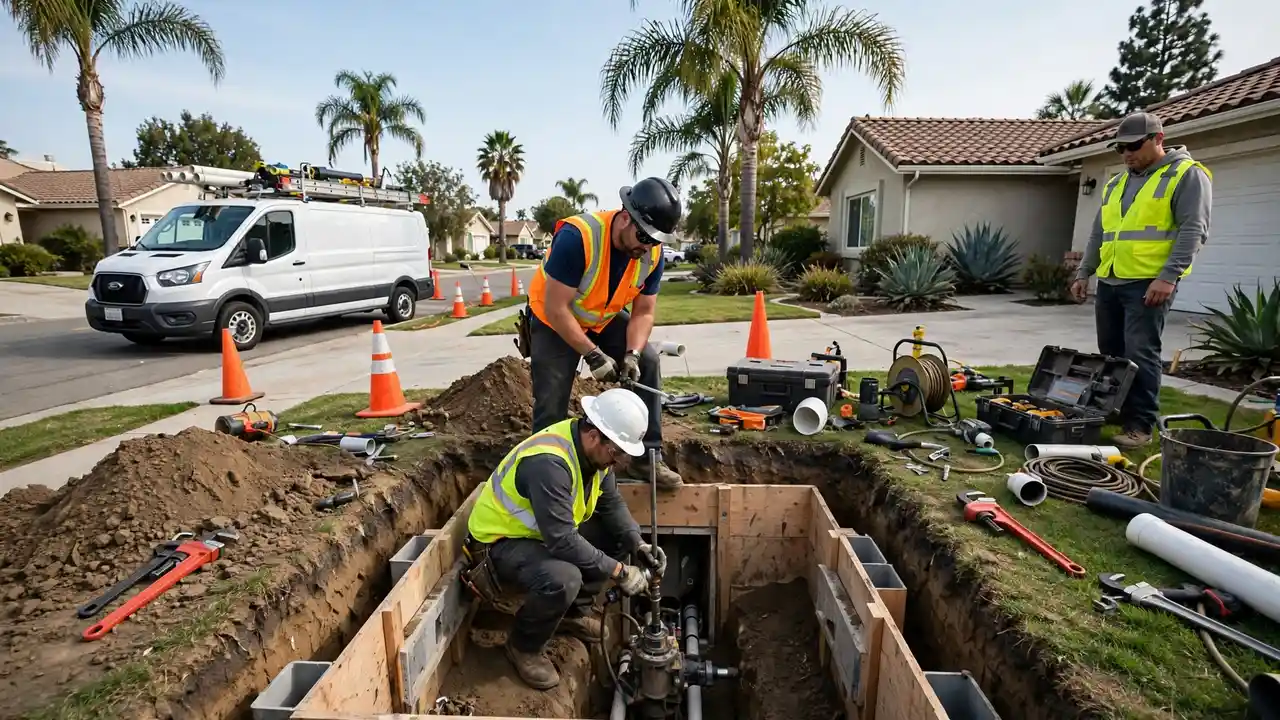
In short: Trenchless sewer repair in Cerritos, CA fixes damaged laterals by lining or pipe bursting through small access points — no full trench across the property — serving Cerritos and nearby LA and Orange County cities. Call (833) 713-2101 for a camera inspection to see if your line qualifies.
For most of plumbing history, fixing an underground sewer line meant one thing: a trench from the house to the street, and everything above it — lawn, driveway, walkways, landscaping — dug up and put back together afterward. Trenchless repair changed the equation. Instead of exposing the pipe, the work happens through it: a new pipe lining is formed inside the old line, or a bursting head pulls a new pipe through the old one's path, and the surface stays largely intact. The sewer gets fixed; the yard barely notices.
Two trenchless methods cover nearly every situation. Cured-in-place pipe lining — CIPP — inserts a resin-saturated liner into the existing line and cures it into a smooth, jointless new pipe within the old one, sealing cracks, bridging missing sections, and locking out roots. Pipe bursting pulls a new pipe through while fracturing the old pipe outward, which handles lines too damaged to line — collapsed sections, severe offsets — while still only digging entry and exit pits. Which method fits depends on the pipe's condition, diameter, and what the camera shows.
Not every line qualifies, and an honest assessment says so up front. A line with a severe belly holding standing water will still hold water after lining — the grade problem needs excavation. A lateral that has lost its path entirely, or one with major sags in multiple spots, may need open trench for part of its run. The camera inspection is what sorts trenchless candidates from dig candidates, and in the Cerritos area the answer is trenchless more often than not: long, straight clay-tile runs under established landscaping are exactly the profile these methods were designed for. Call (833) 713-2101 and the footage will show which category your line falls into.
Signs You Need Trenchless Sewer Repair
Cracked or root-invaded clay tile worth saving
A clay lateral whose joints are failing but whose overall path and grade are sound is the classic lining candidate — the pipe becomes the form for its own replacement.
You want to avoid tearing up landscaping
Mature landscaping, stamped driveways, patios, and pool decks make open trenching expensive to restore — trenchless methods protect the surface investment.
Repeated spot repairs on the same line
A lateral that has collected two or three spot repairs is telling you the whole run is aging; lining or bursting renews it in one project instead of one joint at a time.
Long runs under hardscape or structures
Lines running beneath driveways, sidewalks, or additions are brutally expensive to expose — trenchless methods cross those obstacles underground.
The line is too damaged for cleaning alone
When the camera shows cracks, missing sections, or heavy root entry that cleaning cannot resolve, trenchless renewal fixes the pipe rather than just clearing it.
You need the fix with minimal disruption
Occupied homes, home businesses, and rental properties benefit from trenchless work's smaller footprint — less digging, less time, less restoration afterward.
What Causes Trenchless Sewer Repair Problems
The damage that trenchless methods fix comes from the same forces behind every sewer failure in the region — age, roots, and soil — but trenchless shines precisely where those forces have attacked the joints rather than the grade. The postwar clay-tile laterals of Lakewood, Downey, and Long Beach develop cracked joints and root entry along runs that are otherwise straight and properly sloped; the pipe's path is fine, its walls are the problem. Lining gives those runs a new interior without disturbing a path that was correct from the start. Cast-iron laterals in Artesia and Norwalk corrode from within while holding their grade — another profile where a new interior surface solves the actual failure.
Soil conditions in the LA basin actually favor trenchless work. The sandy-loam alluvium that makes open trenches cave also makes bursting clean: the old clay tile fractures outward easily and the new pipe follows the established path with minimal resistance. High water tables near Long Beach, Carson, and Signal Hill, which turn open trenches into pumping operations, barely affect a lining installation done through existing access points. And in hillside areas of Whittier and Signal Hill, where excavating a slope risks destabilizing it, keeping the work underground is not just convenient — it is the safer engineering choice.
What disqualifies a line is geometry, not age. A bellied section that ponds water will pond water inside a liner too, because lining follows the existing shape — grade defects need excavation and re-bedding. A line that has wandered off its original alignment through decades of soil movement cannot reliably guide a bursting head. Collapsed sections that have lost the pipe's circular path entirely may block liner inversion. The camera inspection maps all of this before anyone commits to a method, which is why the inspection — not a phone estimate — is always step one.
How Trenchless Sewer Repair Works, Step by Step
- 1Call (833) 713-2101 for a camera inspection
The full run is televised from the building to the main: pipe condition, grade, diameter, entry points, and any bellies or collapses are mapped with distances — the footage determines whether lining, bursting, or excavation fits.
- 2Clean and prepare the host pipe
Roots, scale, and debris are cut and jetted out so the liner or bursting head travels cleanly; the camera verifies the pipe is ready and measures exact lengths.
- 3Install the liner or burst the new pipe
For lining, the resin-saturated liner is inverted or pulled into place and cured into a smooth, jointless pipe-within-a-pipe. For bursting, the head fractures the old pipe outward while pulling the new pipe through behind it.
- 4Reinstate connections and verify
Branch connections are reopened robotically from inside, and the camera makes a final pass confirming a continuous, smooth interior from end to end with proper flow.
- 5Restore the access points
Entry and exit pits are backfilled and compacted, cleanouts are secured, and the surface — which saw only small excavations — is restored.
Equipment and Materials
- CIPP lining systems with resin-saturated liners and curing equipment
- Pipe bursting rigs with expander heads sized to residential diameters
- Robotic reinstatement cutters for reopening branch connections from inside
- High-capacity hydro jetters for host-pipe preparation
- Sewer cameras with locators for pre- and post-installation verification
- Compact excavation equipment for entry and exit pits only
Safety on Every Visit
Trenchless work trades the big-trench hazards for a different set that gets equal respect. Resin systems are handled with gloves, eye protection, and ventilation per their safety data — no shortcuts on chemical handling. Bursting rigs operate under high pulling forces, so exclusion zones are kept clear around the pulling equipment and pits. Entry and exit pits, though small, are still shored or sloped where depth requires it. Steam or hot-water curing equipment is managed for burn hazards, and the work area stays barricaded until every pit is backfilled and the surface is safe to walk on.
Trenchless Sewer Repair in Cerritos's Northwest Suburbs
Trenchless repair fits the Cerritos service area like it was designed for it — in many ways it was. The long, straight clay-tile runs under the established tracts of Lakewood, Downey, Long Beach, and Cerritos itself are textbook lining candidates: mature landscaping above that homeowners dread losing, and pipe paths that are sound even where joints have failed. Driveway and sidewalk crossings, common where laterals run under front-yard hardscape in Norwalk, Bellflower, and Paramount, are crossed underground without breaking concrete. Hillside laterals in Signal Hill and Whittier avoid slope excavation entirely. And in the high-water-table flats near Long Beach and Carson, lining through existing access points sidesteps the dewatering battle that open trenching would demand. Call (833) 713-2101 — the camera will confirm whether your street's soil and your line's condition make you a candidate.
Related Sewer Services
Frequently Asked Questions
How do I know if my sewer line qualifies for trenchless repair?
The camera inspection decides: the line's condition, grade, diameter, and the type of damage are all visible on the footage. Sound path with damaged walls usually qualifies for lining; lines too far gone for lining may still qualify for bursting. Call (833) 713-2101 for the inspection that answers it definitively.
What is the difference between pipe lining and pipe bursting?
Lining forms a new jointless pipe inside the existing line, sealing cracks and locking out roots while keeping the same diameter path. Bursting fractures the old pipe outward and pulls a brand-new pipe through in its place, which handles more severely damaged lines. The camera footage determines which method your line needs.
Will trenchless repair reduce the inside diameter of my pipe?
Lining adds a thin wall inside the existing pipe, so the diameter decreases slightly — but the new surface is far smoother than old clay or scaled cast iron, so flow capacity typically improves despite the small reduction. Bursting installs a full-diameter new pipe with no reduction at all.
How much digging does trenchless repair actually require?
Far less than open trench: lining typically needs only existing cleanout access, and bursting needs an entry pit and an exit pit at the ends of the run. Landscaping, driveways, and patios between those points stay untouched.
Can trenchless methods fix a belly or sag in the line?
No — and an honest contractor says so. Lining follows the existing pipe shape, so a bellied section will still hold water after lining. Grade defects need excavation and re-bedding of that section; trenchless methods are for wall and joint damage, not slope problems.
How long does a trenchless repair take compared to digging?
Most residential trenchless projects complete in a fraction of the time of open-trench replacement — often in a day or two of actual work — because there is no long trench to dig, shore, backfill, and restore. The camera inspection and cleaning beforehand set the exact schedule for your line.
Sewer Line Problems Don’t Wait. Neither Should You.
Call now and reach a local sewer line specialist serving Cerritos, CA and nearby northwest suburbs — 24/7.
(833) 713-2101Free to call · No obligation · 24/7 emergency line