
Sewer Camera Inspection in Cerritos, CA
A sewer camera inspection in Cerritos, CA shows exactly what is happening inside your line — roots, cracks, offsets, bellies, breaks — with footage distances and a surface locator reading. Call (833) 713-2101.
- 24/7 emergency line
- Southeast LA County specialists
- Free to call
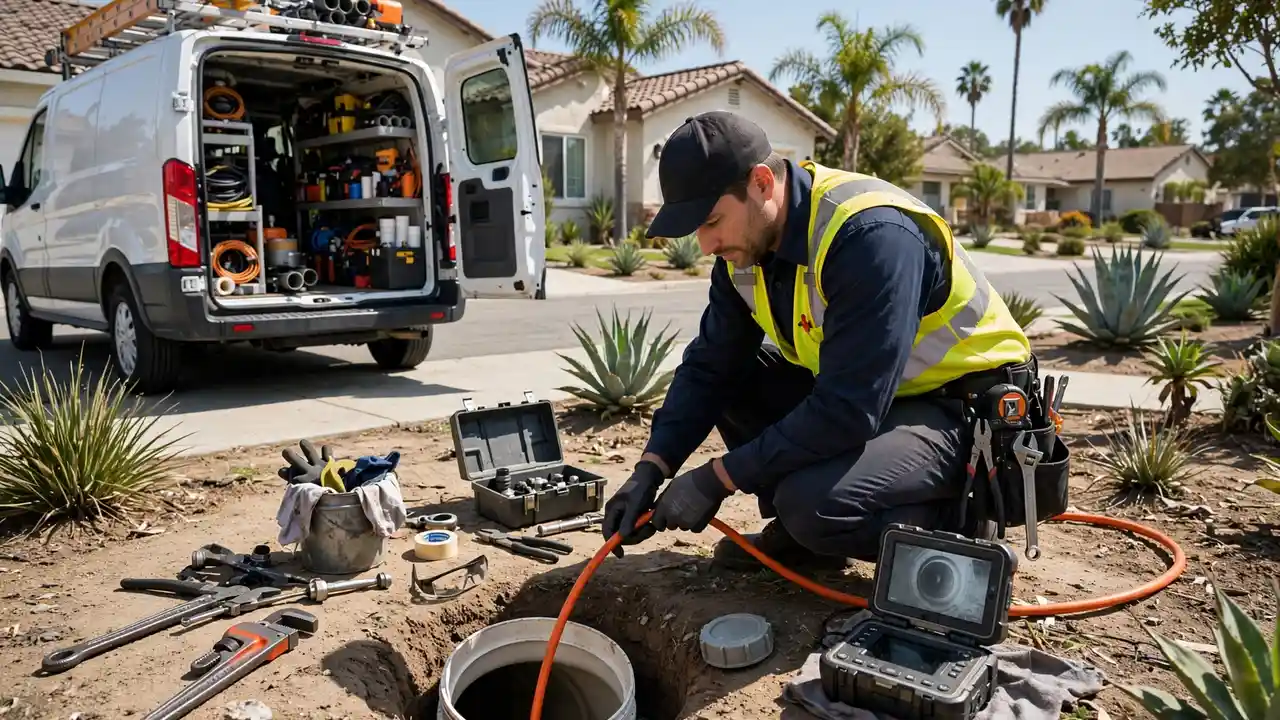
In short: Sewer camera inspection in Cerritos, CA sends a high-resolution camera through your sewer lateral to document its condition, pinpoint problems, and guide the right fix — before anyone talks about digging or trenchless work. Call (833) 713-2101 to schedule an inspection.
Guessing about a sewer line is how simple problems become major ones. A slow drain gets treated with chemicals that do nothing for a root mass; a yard gets trenched to fix a break that was actually twenty feet away; a lateral gets replaced when a single joint was the whole story. A camera inspection ends the guessing: a high-resolution camera travels the line and shows, on a live monitor, exactly what is in the pipe and where.
The equipment does more than show pictures. A footage counter records how far down the line each defect sits, and a sonde transmitter in the camera head lets a surface locator mark the problem's position and depth on the ground above — so a repair crew knows precisely where to dig a small pit or where a trenchless repair should start and end. The inspection is recorded, and you can watch the entire run with the technician.
In the Cerritos area the inspection earns its keep in a few familiar situations: pre-purchase checks on 1950s-70s tract homes in Lakewood, Downey, and Long Beach, where the original clay tile lateral is the same age as the house; locating cleanouts buried under decades of landscaping; verifying that a clearing or jetting actually solved the problem; and mapping the line before a remodel, an addition, or a pool goes over its path.
Signs You Need Sewer Camera Inspection
Drains slowing throughout the house
When sinks, showers, and toilets all drain sluggishly, the restriction is in the shared lateral. A camera shows whether it is roots, scale, a belly, or a break — each with a different fix.
Backups that keep returning after clearing
If the same line backs up again weeks after a clearing, the clearing treated the symptom. The camera finds the defect the cable passed right over: the offset joint, the root entry, the cracked section.
Buying a home in an older tract
In Lakewood, Downey, Long Beach, and the older pockets of Cerritos and Norwalk, the sewer lateral is often original to the house. A pre-purchase camera inspection is the only way to know its true condition before you own it.
Planning a remodel or addition
Before a room addition, a patio cover, or a pool goes over the lateral's path, the line should be mapped and checked. Building over a failing pipe turns a future repair into a demolition project.
Wet spots or lush strips in the yard
Soggy soil or a suspiciously green stripe across the lawn marks where the lateral runs — and possibly where it leaks. The camera confirms whether the wet ground matches a break, a separated joint, or just a sprinkler issue.
Gurgling fixtures and sewer odors
Bubbling toilets, gurgling tubs, and sewage smells with no visible backup suggest a partial blockage or a venting problem downstream. The camera distinguishes between the two in one visit.
What Causes Sewer Camera Inspection Problems
Cameras in the Cerritos trade area tend to find the same cast of characters. Ficus root masses at clay tile couplings are the most common sight — fine white tendrils in summer that become woody blockages by winter. Seismic offsets show as joints stepped inches apart, sometimes with daylight visible through the gap. Bellies appear wherever sandy loam has settled beneath the pipe, holding standing water the camera must push through. In the older cast-iron stock, the lens shows internal scale narrowing the pipe like plaque in an artery.
Storm season adds its own footage: after the first atmospheric river of November or December, cameras catch groundwater streaming into cracked joints — infiltration that explains why a line behaves in October and floods in January. Orangeburg shows up in the oldest postwar pockets, ovaled and blistered. And every so often the camera finds the simplest cause of all: construction debris, a shifted cleanout cap, or a lateral crushed where a fence post went in.
How Sewer Camera Inspection Works, Step by Step
- 1Call and describe the situation
Call (833) 713-2101 and say what is happening — slow drains, a pending home purchase, a planned remodel — so the technician brings the right camera setup and access tools.
- 2Access through a cleanout
The camera enters through an existing cleanout whenever one is available. If the property has none, the technician can pull a toilet for access or locate and expose a buried cleanout — common in older tract homes.
- 3The camera run with live viewing
The camera head travels the full lateral to the city main while you watch on the monitor. The technician narrates what the lens sees: pipe material, joints, roots, cracks, offsets, and standing water.
- 4Locating problems on the surface
Wherever the camera finds a defect, the sonde locator marks its position and depth on the ground above — marked and measured — so any future repair starts at exactly the right spot.
- 5Recorded findings and a plain-language summary
You receive the recorded inspection and a clear explanation of what was found, what it means, and which fixes fit — repair, lining, bursting, or simply monitoring — with no pressure to decide on the spot.
Equipment and Materials
- High-resolution push camera with self-leveling head
- Sonde transmitter with surface locator and depth readout
- Footage counter for exact defect distances
- Monitor with recording for the full inspection run
- Cleanout access and retrieval tools
- Hydro jetter for pre-cleaning when the line needs it first
Safety on Every Visit
Camera inspection is the lowest-impact sewer service there is: no excavation, no chemicals, no heavy equipment. The safety focus is straightforward — sanitary handling of the camera cable and equipment, keeping the access area clear and clean, and making sure pulled toilets are reset with fresh seals. The property looks the same when the technician leaves as when they arrived.
Sewer Camera Inspection in Cerritos's Northwest Suburbs
Local practice makes the camera inspection close to standard procedure. Pre-purchase sewer inspections are routine in the Lakewood, Downey, and Long Beach tracts, where buyers inherit 60-year-old clay tile laterals under mature ficus trees. Buried cleanouts are a regional specialty — decades of landscaping and patio work have hidden them on countless properties, and the locator finds them without exploratory digging. Near the coast, high water tables in Long Beach and Los Alamitos can mask a leak's signs on the surface, which makes the camera's inside view the reliable witness. And on the Signal Hill and Whittier hillsides, the locator's depth readings guide repairs where the lateral drops with the slope.
Related Sewer Services
Frequently Asked Questions
Do I need a cleanout for a camera inspection?
It helps, but its absence is not a blocker. Many older tract homes in the area were built without one or had it buried under landscaping. The technician can pull a toilet for camera access, or use the locator to find and expose a buried cleanout.
How far into the line can the camera go?
Residential push cameras typically travel the full lateral from the house to the city main — usually well over a hundred feet — which covers the entire section the homeowner is responsible for.
Will I be able to see what the technician sees?
Yes. The inspection runs on a live monitor, the technician narrates the findings as the camera travels, and the full run is recorded so you can rewatch it or share it with a contractor, buyer, or seller.
Can the camera tell you exactly where a problem is?
Yes — that is the locator's job. A transmitter in the camera head lets the receiver mark the defect's position and depth on the surface above, so a repair crew knows precisely where to work instead of exploratory digging.
Should I get a camera inspection before buying a home here?
In the area's 1950s-70s tracts, strongly consider it. The original clay tile lateral is the same age as the house, and its condition is invisible without a camera. Buyers use the findings to negotiate repairs or plan for replacement on their own timeline.
Does the line need to be cleaned before the inspection?
Sometimes. If the line is heavily blocked, the camera cannot see past the obstruction, so a clearing or jetting comes first and the camera follows to verify the pipe's true condition. The technician will tell you during the call whether your situation likely needs that sequence.
Sewer Line Problems Don’t Wait. Neither Should You.
Call now and reach a local sewer line specialist serving Cerritos, CA and nearby northwest suburbs — 24/7.
(833) 713-2101Free to call · No obligation · 24/7 emergency line