
Trenchless Sewer Repair: Honest Limitations
Trenchless methods save yards and driveways — but they can't fix everything. An honest look at when lining and bursting won't work and excavation is the better call.
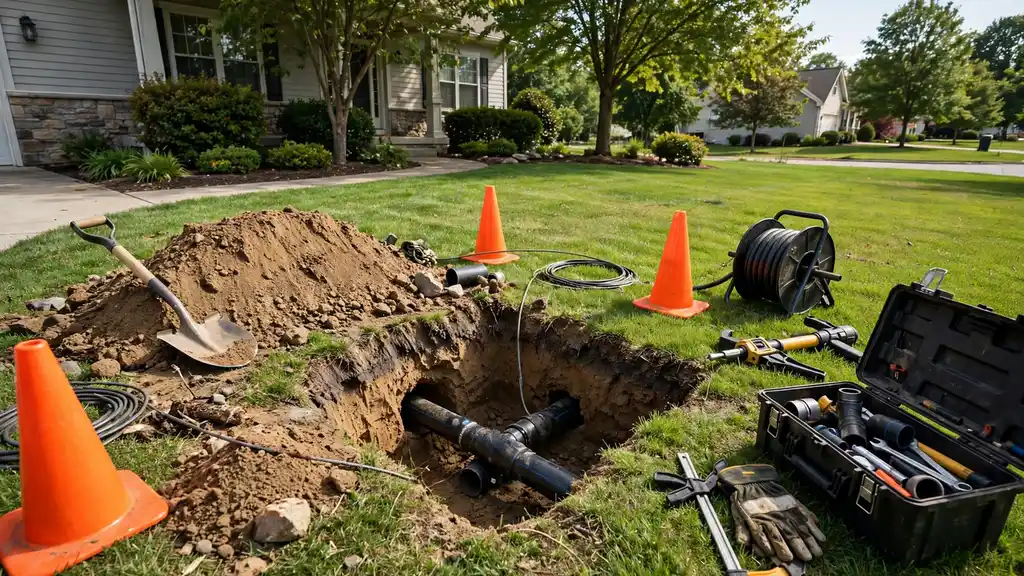
In short: Trenchless sewer repair — lining a pipe from the inside or bursting it apart to pull a new pipe through — has earned its popularity honestly. It saves landscaping, driveways, and patios from the trench, and for the right pipe it produces a result every bit as durable as open-cut replacement. But trenchless is a
Trenchless sewer repair — lining a pipe from the inside or bursting it apart to pull a new pipe through — has earned its popularity honestly. It saves landscaping, driveways, and patios from the trench, and for the right pipe it produces a result every bit as durable as open-cut replacement. But trenchless is a set of techniques with prerequisites, not magic, and a contractor who recommends it for every job is selling, not diagnosing.
This guide covers the genuine limitations of trenchless methods: the pipe conditions that rule them out, the grade problems they cannot correct, and the site constraints that make traditional excavation the smarter choice. Knowing these boundaries protects you in both directions — from paying for trenchless where it will fail, and from unnecessary digging where trenchless would have worked. As always, a camera inspection is what determines which side of the line your pipe falls on.
Trenchless needs a host pipe
Both main trenchless methods depend on the old pipe in different ways. Cured-in-place lining uses the existing pipe as a mold: a resin-saturated liner is inverted into the old pipe and cured against its walls. Pipe bursting uses the old pipe as a guide path, fracturing it outward while pulling the new pipe through. In both cases, the old pipe must be substantially present and roughly on its original line.
A fully collapsed section breaks that deal. Where the pipe has caved in and soil has filled the void, there is no channel for a liner to follow and no path for a bursting head to track — the equipment simply cannot get through. Severely offset joints, where one section has dropped well below its neighbor, create a similar impassable step. These are the cases where even the most enthusiastic trenchless contractor should recommend excavation, and a camera inspection makes the collapsed section unmistakable.
Grade problems: bellies and backfall
A sewer works on gravity, and gravity needs consistent downhill slope. A belly — a sagging section where the pipe dips and rises again — holds standing water, and standing water collects grease and solids no matter how smooth the pipe interior is. Lining follows the existing pipe's shape, so a lined belly is still a belly: smoother, but still holding water. Pipe bursting can sometimes correct minor sags by pulling the new pipe on a truer line, but it cannot fix a fundamentally wrong grade.
Backfall — pipe that actually slopes the wrong way — is even less negotiable. No trenchless method changes the elevation of a pipe run; only excavation and re-bedding can re-establish proper slope. When the camera shows water ponding in a sag or flowing backward, the honest recommendation is to dig that section and rebuild the grade, even if the rest of the run is a candidate for trenchless rehabilitation.
Access and site constraints
Trenchless equipment needs room to work. Pipe bursting requires entry and exit pits — small excavations, but excavations nonetheless — and lining needs access at both ends of the run. A lateral buried under a room addition, a pool, or a structure with no accessible endpoints can defeat the method before it starts. Extremely short runs sometimes fail the practicality test too: the mobilization for trenchless equipment can exceed the effort of simply digging a short trench.
Underground congestion is another constraint. In neighborhoods where gas, electric, water, and communications share crowded utility corridors, bursting — which displaces soil outward — risks disturbing adjacent lines, and access pits may land on top of other utilities. A responsible contractor locates all utilities before recommending a method, and crowded ground is a legitimate reason to choose careful open-cut excavation with full visibility.
When the pipe is simply too far gone
There is a spectrum from damaged to destroyed, and trenchless lives on the damaged end. A pipe with cracks, root intrusion, scale, and moderate offsets is the ideal candidate. A pipe that has lost long stretches of its bottom to corrosion, crumbled into fragments, or been crushed flat by soil pressure has nothing left to line and no path to burst through. Orangeburg fiber pipe that has fully deformed falls squarely in this category.
Partial collapses occupy a gray zone: sometimes a short collapsed section can be spot-excavated and repaired, with the remaining sound run rehabilitated trenchlessly — a hybrid approach that limits digging to the worst few feet. This is where an experienced diagnosis earns its keep, and where pipe bursting versus open-cut becomes a judgment call based on footage, not a reflex.
The bottom line: let the footage decide
None of these limitations are arguments against trenchless repair — they are arguments against one-size-fits-all recommendations. Most residential laterals with typical age-related defects qualify for trenchless methods, and the yard-saving benefits are real. The failures happen when the method is chosen before the diagnosis: lining a collapsed pipe, bursting through a belly, or digging up a yard that lining would have spared.
Protect yourself with a simple sequence: camera inspection with recorded footage you keep, a written diagnosis that names the specific defects and their locations, and a method recommendation tied to that footage. Any contractor — trenchless specialist or excavator — should be able to explain why the chosen method fits your pipe. If the explanation does not reference what the camera showed, get a second opinion before anyone breaks ground. Call (833) 713-2101 to start with the inspection.
Frequently Asked Questions
Can a collapsed sewer line be fixed without digging?
Usually not. A fully collapsed section has no open channel for lining equipment to follow and no path for a bursting head to track. The standard fix is excavating the collapsed section — sometimes just those few feet, with the rest of the run rehabilitated trenchlessly.
Will pipe lining fix a sagging or bellied pipe?
No. Lining conforms to the existing pipe's shape, so a lined belly still holds standing water. Bellies and backfall (wrong-direction slope) can only be corrected by excavating and re-establishing proper grade.
Does trenchless work on Orangeburg pipe?
Only if the Orangeburg is still holding its shape. Deformed or softened fiber pipe cannot host a liner and may not burst cleanly. Intact Orangeburg can sometimes be burst, but collapsed or ovalized sections need excavation.
How do I know if my pipe qualifies for trenchless?
A sewer camera inspection. The footage shows collapses, offsets, bellies, and the pipe's overall structural condition — exactly the factors that determine whether lining or bursting will work. No reputable contractor recommends a method without this footage.
Is a hybrid repair — part trenchless, part dig — common?
Yes, and it is often the smartest approach. A short collapsed or bellied section gets spot-excavated while the remaining sound run is lined or burst. You get the durability of a full rehabilitation with digging limited to the few feet that truly need it.
Sewer Line Problems Don’t Wait. Neither Should You.
Call now and reach a local sewer line specialist serving Cerritos, CA and nearby northwest suburbs — 24/7.
(833) 713-2101Free to call · No obligation · 24/7 emergency line