
What Causes Sewer Line Collapse
A collapsed sewer line is the worst-case failure — and it rarely happens without years of warning. The seven most common causes, and how to catch them early.
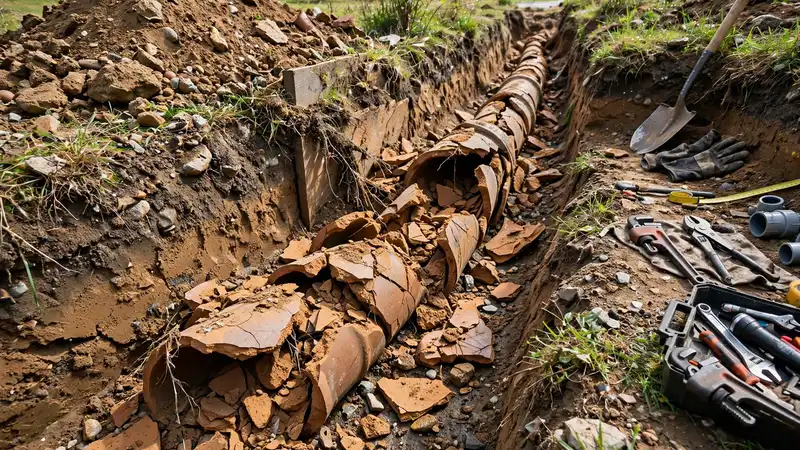
In short: A collapsed sewer line is the failure every homeowner dreads: the pipe caves in, wastewater has nowhere to go, and the fix almost always involves excavation. Yet collapses are rarely sudden events. They are the end stage of deterioration that usually took years — corrosion thinning a pipe wall, soil shifting a joint, roots widening
A collapsed sewer line is the failure every homeowner dreads: the pipe caves in, wastewater has nowhere to go, and the fix almost always involves excavation. Yet collapses are rarely sudden events. They are the end stage of deterioration that usually took years — corrosion thinning a pipe wall, soil shifting a joint, roots widening a crack — progressing quietly underground until the structure gives way. Understanding what causes collapse is really about learning to read the years of warning that precede it.
This guide walks through the seven most common causes of sewer line collapse in Southern California, from aging materials to seismic soil movement, and explains what early intervention looks like for each. If your lateral is decades old and has never been inspected, a camera inspection is how you find out whether you are dealing with early-stage deterioration or a pipe already approaching failure.
1. Aging materials reaching their limit
Every pipe material has a service life, and the 1950s–70s laterals common in Cerritos are living on borrowed time in many cases. Cast iron corrodes from the inside through tuberculation until the wall thins and the bottom channels through. Clay tile itself endures, but decades of joint movement leave sections unsupported and vulnerable. Orangeburg fiber pipe — used in some mid-century California tracts — softens with moisture absorption until it deforms and caves under ordinary soil pressure.
Age alone does not collapse a pipe; age plus the stresses below does. But when a lateral is past its expected service life, the margin for every other problem on this list shrinks to zero. A camera inspection of an older line is less about finding today's emergency and more about measuring how much structural margin remains.
2. Soil movement and seismic activity
The LA basin moves. Expansive clay pockets swell with winter rain and shrink in summer drought, heaving and settling the ground around buried pipe. Add Southern California's seismic reality — even minor tremors flex rigid pipe and work joints loose — and underground infrastructure here lives a more eventful life than in calmer geology. Each cycle of movement stresses joints and bedding a little more.
The damage is cumulative and invisible from the surface: a joint offsets a fraction of an inch, bedding washes out from under a section, a crack opens at a stress point. Over years, these small movements concentrate load on weakened sections until one gives way. Homes on slopes or near drainage channels see more movement, but no Cerritos lateral is entirely exempt from the ground shifting beneath it.
3. Groundwater infiltration and soil voids
A cracked pipe does not just leak wastewater out — it lets groundwater and fine soil in. During heavy rain, especially the atmospheric-river storms that have battered Southern California in recent years, water enters through cracks and washes the fine soil from around the pipe into the flow. Over time this creates voids — empty pockets in the soil surrounding the pipe — and a pipe spanning a void is a bridge carrying soil load it was never designed for.
This is the quietest path to collapse because the surface often shows nothing until the void migrates upward and a depression appears in the yard. Camera footage can reveal the early signs: infiltration staining, sediment deposits inside the pipe, and sections where the pipe has begun to oval under uneven support. Catching infiltration early is one of the highest-value outcomes of periodic inspection and cleaning, because sealing the cracks starves the whole process.
4. Tree root pressure
Roots are usually discussed as a blockage problem, but they are also a structural one. A root mass entering through a joint keeps growing, and the hydraulic pressure of expanding roots can widen cracks, displace sections, and pry joints further apart. In clay tile laterals — where every short joint is a potential entry point — decades of root pressure can literally push sections out of alignment.
The cruel irony is that the blockage symptoms often mask the structural damage: the line gets cleared, flow is restored, and the displaced joint that the roots were widening goes unnoticed. This is why root intrusion should always prompt a structural look at the entry points, not just a cutting. Roots plus an already-aged pipe is the combination that most often ends in collapse — and the reason root removal paired with camera assessment matters more than cutting alone.
5. Heavy surface loads
Sewer pipe is designed to carry soil load, not point loads it was never meant to bear. Heavy vehicles driving over a shallow lateral — delivery trucks cutting across a yard, construction equipment during a remodel — can crack or crush pipe, especially older rigid materials like clay and cast iron. Even a parked RV or a loaded dumpster sitting over a shallow run for weeks applies sustained pressure the pipe was not designed for.
The risk concentrates where burial is shallow: near the house foundation, under side yards, or where grading has eroded cover over the years. If construction or heavy equipment will cross your yard, find out where the lateral runs first — a camera inspection maps its path — and keep the loads off it. A crushed section from a single afternoon of heavy equipment is one of the most preventable collapses there is.
6. Poor original installation
Some collapses were programmed in on installation day. A lateral laid without proper bedding — the compacted gravel cradle that distributes soil load evenly — develops stress concentrations at hard spots. Joints assembled carelessly leak from the start, inviting the root and infiltration problems described above. Backfill containing construction debris or large rocks presses directly against the pipe wall instead of cushioning it.
These defects do not announce themselves. The line works fine for years while the bedding slowly consolidates unevenly and joints work loose. By the time symptoms appear, the installation defect has usually recruited allies — roots at the leaking joints, voids from infiltration — and the collapse looks like bad luck rather than the foreseeable outcome it was. Older tracts, built fast during the housing boom, deserve particular skepticism about what is underground.
7. Years of neglected maintenance — and how to get ahead of it
The final cause is not a physical force but a human one: nobody looked. Every mechanism above — corrosion, joint movement, infiltration, root entry — is detectable years before collapse with a camera, and most are manageable when caught early. Scale can be jetted, roots can be cut and their entries sealed, small cracks can be lined, and a deteriorating run can be replaced on a planned schedule instead of under emergency conditions. Trenchless rehabilitation in particular turns many would-be collapses into planned, low-disruption projects.
If your Cerritos home still has its original 1960s or 70s lateral and it has never been inspected, you are flying blind on all seven of these risks at once. A single camera inspection converts unknown unknowns into a concrete punch list — and whether the news is good or bad, knowing beats guessing. Call (833) 713-2101 to schedule an inspection and find out where your line stands before the ground makes the decision for you.
Frequently Asked Questions
Can a sewer line collapse without any warning signs?
True no-warning collapses are rare. Most are preceded by years of symptoms — recurring slow drains, gurgling, soggy yard patches, or roots that keep returning. The sudden part is usually just the moment the weakened structure finally gives way, long after the deterioration began.
Does homeowners insurance cover a collapsed sewer line?
Coverage varies widely by policy. Standard policies often exclude sewer line failures or cover only resulting water damage, not the pipe repair itself; some carriers offer a sewer line endorsement. Review your policy and consider asking your agent specifically about lateral coverage before you need it.
How long does it take for a sewer line to collapse?
There is no fixed timeline — it depends on material, soil, and maintenance. A well-maintained plastic line may never collapse; a neglected Orangeburg line can deform within a few decades. The deterioration behind most collapses progresses over years, which is why periodic inspection is effective prevention.
Can earthquakes collapse a sewer line?
Seismic shaking can damage rigid sewer pipe and loosen joints, especially in older clay and cast-iron lines. Even minor tremors contribute to the cumulative joint movement that weakens a line over time. After significant shaking, an inspection is prudent for older laterals.
If my line collapsed, do I have to dig up the whole yard?
Not necessarily. Excavation is required at the collapsed section itself, but the remaining sound portions of the run can often be rehabilitated trenchlessly — a hybrid approach that limits digging to the failed stretch.
Related reading
Sewer Line Problems Don’t Wait. Neither Should You.
Call now and reach a local sewer line specialist serving Cerritos, CA and nearby northwest suburbs — 24/7.
(833) 713-2101Free to call · No obligation · 24/7 emergency line