
How a Sewer Line Gets Installed, Step by Step
A new sewer lateral is more than a trench and a pipe. Here is the full installation process — planning, excavation, pipe setting, and inspection — and what to watch as a homeowner.
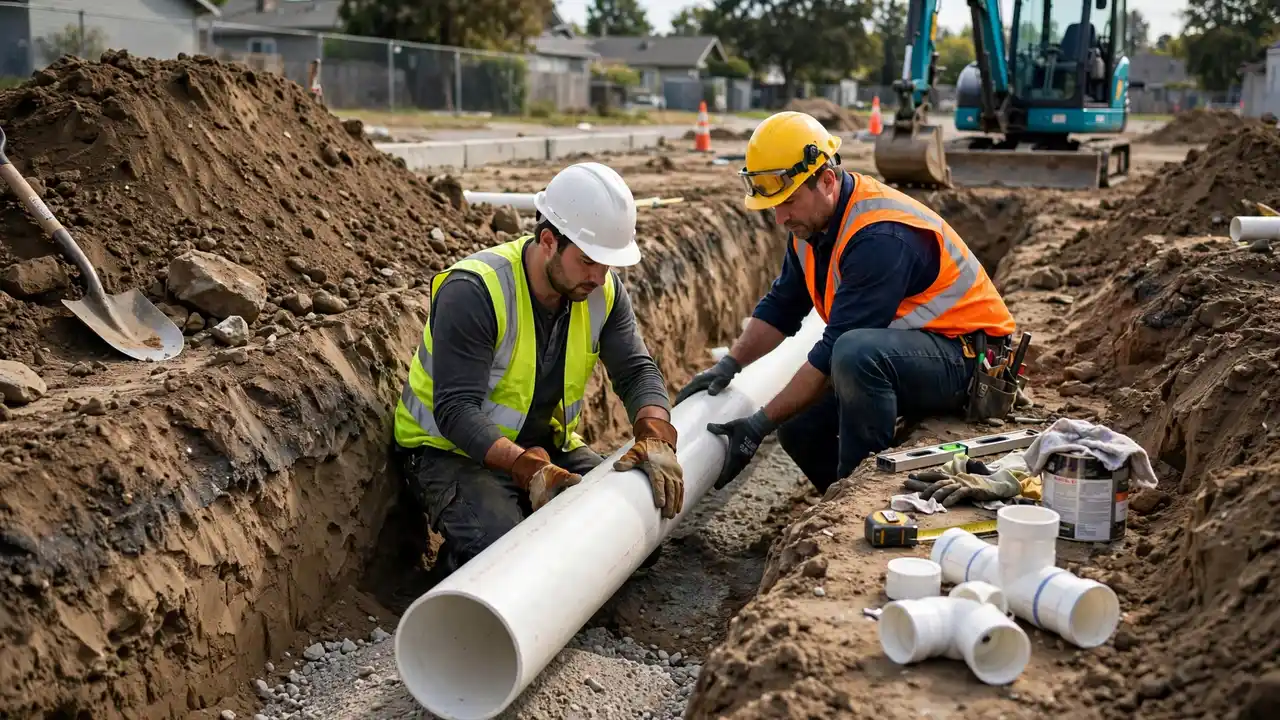
In short: Most homeowners only think about sewer line installation when they have no choice: a collapsed lateral, a failed sewer line replacement project, or a new accessory dwelling unit that needs its own connection. But understanding how a proper installation happens pays off even if you never watch one — it tells you what a good
Most homeowners only think about sewer line installation when they have no choice: a collapsed lateral, a failed sewer line replacement project, or a new accessory dwelling unit that needs its own connection. But understanding how a proper installation happens pays off even if you never watch one — it tells you what a good contractor's bid should include, which corners get cut in bad installations, and why some lines last generations while others fail in twenty years.
The process follows the same sequence on every job: permits and planning, utility locating and layout, excavation, setting the pipe on proper bedding at the right slope, inspection, and careful backfill. This guide walks through each stage as it applies to Cerritos homes — slab foundations, LA basin soils, mid-century tract layouts — so you can follow along knowledgeably whether you are replacing a failed lateral or connecting new construction.
Permits and planning before the first shovel
Every legal sewer installation in Cerritos starts with permits from the city and, where the work touches the public right-of-way or the main connection, coordination with the sanitation district. The permit application typically includes a site plan showing the lateral's route from the house to the main, the pipe material and diameter, and the cleanout locations. Plan review catches problems early: a route that crosses an unrecorded easement, a slope that will not drain, or a connection point the district will not approve.
Planning also covers what the crew will encounter underground. In Cerritos tracts, that means LA basin soils — sandy loams and clays that dig easily but cave readily, requiring shoring in deeper trenches — and the maze of existing utilities in shared side-yard corridors. A contractor who pulls permits, calls in utility locates, and walks the route with you before mobilizing is doing the unglamorous work that separates lasting installations from callbacks.
Locating utilities and laying out the trench
Before excavation, every known underground utility along the route gets marked: gas, water, electric, communications, and any existing sewer. California law requires calling 811 for public utility locates, and on a typical Cerritos lot the private lines — the water service from the meter, landscape lighting, old abandoned pipes — need locating too, since 811 does not mark those. Striking an unmarked gas or electric line is the nightmare scenario, and it is entirely preventable with proper locating.
With utilities marked, the crew lays out the trench path from the building exit to the main connection, usually the shortest route that maintains proper slope and avoids other utilities. The building exit point matters on slab homes: the new lateral must tie into the existing under-slab plumbing at the right elevation, which sometimes means opening a small section of slab inside or just outside the foundation. Surface locating with a transmitter confirms the old line's path so the new trench does not cross it blindly.
Setting the pipe: bedding, slope, and joints
This is the stage that determines whether the line lasts eighty years or twenty. The trench bottom gets shaped and compacted, then lined with bedding material — usually crushed rock or sand — that cradles the pipe evenly along its full length. Pipe laid directly on lumpy native soil develops stress points and bellies; pipe on uniform bedding stays round and holds its slope. In the expansive clay pockets found in parts of the LA basin, proper bedding also cushions the seasonal swell-and-shrink movement that cracks poorly supported pipe.
Slope is the other make-or-break detail. A sewer lateral needs enough fall to carry solids along — typically around a quarter inch per foot — but not so much that water outruns the solids and leaves them behind. The crew sets the pipe with a level or laser, checking continuously, because a flat spot becomes a permanent sediment trap and an over-steep section becomes a chronic clog point. Joints get assembled per the pipe manufacturer's spec — gasketed or solvent-welded depending on material — and each joint is checked for full insertion before the next section goes in. Rushing this stage is how new lines end up with the same bellies and offset joints that doomed the old one.
Inspection, backfill, and restoration
Before any dirt goes back in the trench, the installation gets inspected — typically by the city inspector for the private lateral and by the district for the main connection. The inspector checks pipe material, slope, bedding, joint assembly, and cleanout placement against the approved plan. Some jurisdictions also require a water or air test of the new line to prove it is watertight. A contractor who welcomes inspection is a contractor with nothing to hide; never let a crew backfill before the inspection is signed off.
Backfill is done in compacted lifts, not dumped in all at once. The crew places bedding material around the pipe's sides — the haunch zone that keeps the pipe round under load — then compacts soil in thin layers above, testing compaction as they go. Sloppy backfill settles over the following year, leaving a sunken trench line across the yard and, worse, letting the pipe settle unevenly and lose its slope. Final restoration — concrete, pavers, sod — comes last, and a good contract specifies who restores what, since the excavation crew and the concrete crew are often different trades.
What homeowners should watch during the job
You do not need to supervise the crew, but a few checkpoints protect your interests. Confirm the permit card is posted and inspections are scheduled before backfill. Ask to see the pipe's slope readings or the laser setup — a professional crew will show you without defensiveness. Photograph the open trench with the pipe and bedding visible before it is covered; those photos are invaluable if a problem ever arises, and they document exactly what is buried where.
Also confirm the cleanouts: every installation should leave accessible cleanouts at the building exit and at intervals along long runs, with caps at or near finished grade — not buried under a foot of soil. And get the as-built in writing: the final route, depths, and connection point, ideally with a camera inspection of the new line on record. A new lateral installed to spec in Cerritos soils should serve for generations; the paperwork proving it was installed to spec is what protects that investment. Call (833) 713-2101 if you are planning a replacement and want the process explained for your specific lot.
Frequently Asked Questions
How long does a sewer line installation take?
Most residential lateral replacements are completed in a few days of active work, with the open-trench portion often finished in one to two days. Permits, inspections, and concrete restoration add calendar time around the digging, so the full project typically spans one to two weeks.
What pipe material is used for new sewer laterals?
Modern installations in this area typically use PVC or ABS plastic pipe with gasketed or solvent-welded joints, chosen for smooth interiors and corrosion resistance. The permit plans specify the material, and the inspector verifies it matches before backfill.
Will installation destroy my landscaping?
Open-trench installation disturbs the ground along the trench path, and plants directly over the route usually cannot be saved. Discuss the route with your contractor beforehand — sometimes a slightly longer path avoids a prized tree — and consider trenchless options where the pipe's path allows them.
Do I need to leave my home during installation?
Usually not. Water service stays on for most of the job, though drains and toilets are out of service while the lateral is disconnected and reconnected — typically a matter of hours on the cutover day. Your contractor should tell you exactly when to avoid using plumbing.
What warranty should a new sewer line carry?
Ask for the warranty terms in writing before work begins: reputable contractors warrant their workmanship for a defined period, and pipe manufacturers warrant the pipe itself separately. Keep the permit sign-offs, inspection records, and as-built drawings with your home files.
Related reading
Sewer Line Problems Don’t Wait. Neither Should You.
Call now and reach a local sewer line specialist serving Cerritos, CA and nearby northwest suburbs — 24/7.
(833) 713-2101Free to call · No obligation · 24/7 emergency line