
Sewer Leak Detection Methods, Compared Side by Side
Not every suspected sewer leak needs the same test. Here is how camera inspection, smoke testing, dye testing, and hydrostatic testing compare — and which one fits your situation.
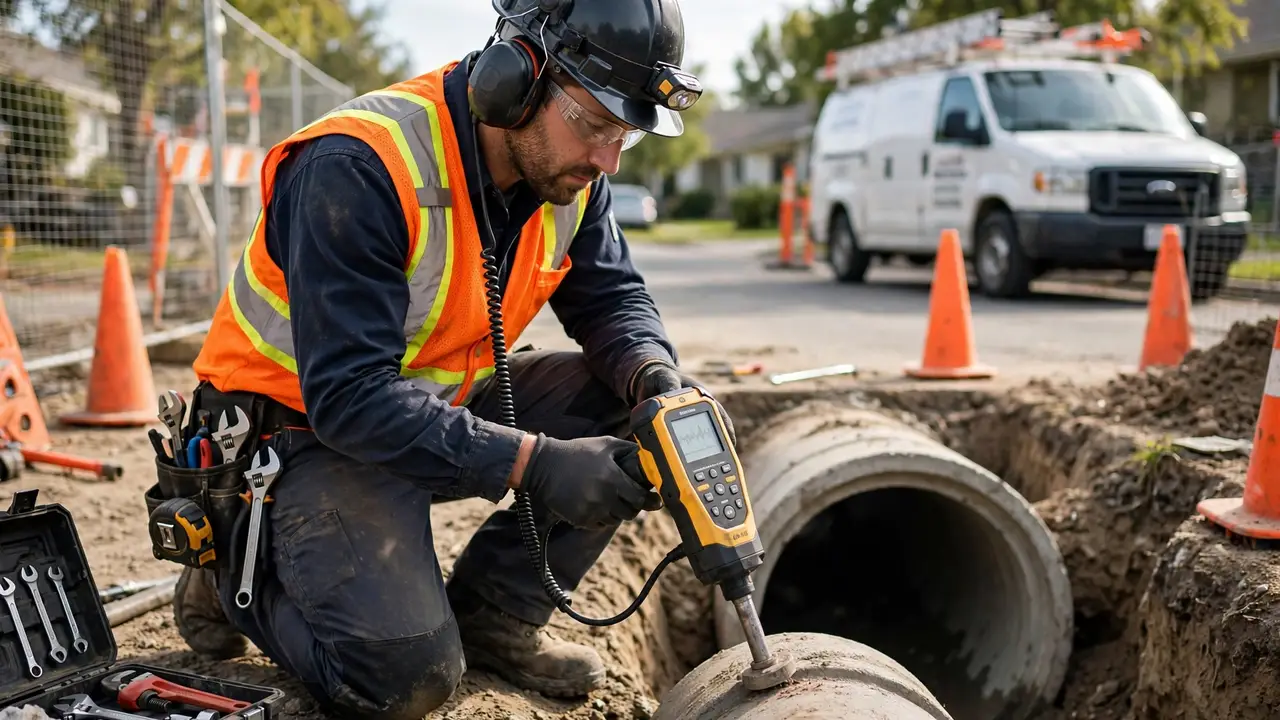
In short: A wet spot in the yard, a water bill that climbs for no reason, the faint smell of sewage near a cleanout — each of these hints at a sewer leak, but none of them says exactly where the leak is or how bad it is. That gap between symptom and diagnosis is where leak
A wet spot in the yard, a water bill that climbs for no reason, the faint smell of sewage near a cleanout — each of these hints at a sewer leak, but none of them says exactly where the leak is or how bad it is. That gap between symptom and diagnosis is where leak detection methods earn their keep. Used well, they turn a vague worry into a marked spot on the ground and a clear picture of the pipe's condition.
Cerritos adds its own wrinkles to the choice of method. Slab foundations hide the lateral's first stretch under concrete, mid-century clay tile joints fail differently than aging cast iron, and LA basin soils move enough to shift pipe sections without fully breaking them. This guide compares the four detection methods technicians actually use — camera inspection, smoke testing, dye testing, and hydrostatic (static) testing — so you can understand what each one proves, what it cannot prove, and which combination fits your symptoms before anyone discusses sewer line repair.
Camera inspection: the visual baseline
The camera is the starting point for almost every leak investigation, because it shows the pipe's interior directly. A technician feeds the camera from the cleanout to the city main while watching for the visual signatures of leaks: cracks with soil visible through them, separated joints with gaps at the bell, holes where the pipe wall has given way, and active infiltration where groundwater seeps in. The footage counter ties each finding to a distance, and the transmitter marks the spot on the surface, which is how a leak under a slab or driveway gets located without exploratory digging.
The camera's limitation is that it sees the inside of the pipe, not the soil around it. A joint that weeps only during storms may look merely damp on a dry day, and a hairline crack above the waterline can be easy to miss if the lens is riding low in standing water. That is why the camera is a baseline rather than the whole answer: it identifies structural damage with certainty, and when the footage looks clean despite real symptoms, the investigation moves to methods that test the system as a whole.
Smoke testing: finding where gas escapes
Smoke testing works on a simple principle: if air can get out, water and gas can too. The technician seals the system and blows a dense, non-toxic theatrical smoke into the line, then watches where it surfaces. Smoke curling from a crack in a vent pipe inside a wall, seeping from the soil above a broken lateral, or drifting from a dry floor drain maps every escape route in one pass — including leaks the camera never saw because they sit above the waterline or outside the pipe's interior view.
This method shines in two Cerritos scenarios. The first is a persistent sewer odor with clean camera footage, where the leak is likely in the vent system or at a fixture seal rather than in the buried lateral. The second is a suspected break under landscaping, where smoke rising from the soil pinpoints the dig site better than any guess. Smoke testing does not measure the size of a leak or the pipe's remaining life, so it pairs with the camera rather than replacing it.
Hydrostatic testing: does the line hold water?
Hydrostatic, or static, testing answers a pass-or-fail question: does this section of pipe hold water? The technician plugs the line, fills it to a set level, and watches whether the level drops over a timed period. A steady level means the pipe is watertight; a dropping level proves a leak exists somewhere in the tested section, even if the camera could not see it. For under-slab laterals in Cerritos tract homes, where the pipe is inaccessible and excavation is costly, this test settles the question of whether a leak exists before anyone commits to breaking concrete.
The trade-off is precision. A failed test proves a leak but does not show where it is — the location work still falls to the camera or to isolating smaller sections and retesting. A passed test is reassuring but not absolute, since a crack that only opens under soil movement or root pressure can hold water on a calm day. Technicians use hydrostatic testing as a gate: pass, and the search narrows to vents and fixtures; fail, and the camera goes back in with a confirmed leak to find.
Dye testing and acoustic listening
Dye testing is the least equipment-intensive method in the kit. Bright, non-staining tracing dye goes into a fixture or a section of line, and the technician watches where color appears — in a neighboring drain, in a puddle near the foundation, or in a sump area. It is a connectivity test: it proves that two points are linked by flowing water, which settles arguments about whether a wet spot comes from the sewer line, a sprinkler, or groundwater. It will not find the exact crack, but it answers the which-system question cheaply and fast.
Acoustic listening, using ground microphones to hear water escaping under pressure, sees more use on pressurized water lines than on gravity sewer laterals, which run mostly empty and quiet. On a sewer line it has a niche role: confirming active flow through a suspected break during a dye or hydrostatic test, or checking whether a line thought to be abandoned still carries water. Neither method replaces the camera; both are supporting players that answer specific questions the camera cannot.
Choosing the right method for your situation
Match the method to the symptom. Recurring backups and slow drains call for the camera first, since the problem is visible inside the pipe — roots, scale, bellies, collapses. A sewer smell with no drainage trouble points to smoke testing, because the failure is likely in the venting or at a seal. A wet yard spot or an unexplained water intrusion near the foundation suggests dye testing to confirm the source, then the camera to find the break. A suspected under-slab leak with no visible evidence is the classic case for hydrostatic testing as the deciding vote.
In practice, careful investigations use two methods: the camera for structure, plus one test for behavior. Ask the technician what each proposed test is meant to prove and what happens if it comes back negative — a good answer names the next step, not just the current one. And whatever the findings, insist on seeing the evidence yourself, whether that is footage, smoke surfacing on video, or a documented water-level drop, before authorizing trenchless sewer repair or any excavation. Call (833) 713-2101 to start with a camera inspection and build the diagnosis from there.
Frequently Asked Questions
How do the leak detection methods compare on accuracy?
No single method wins on its own. The camera shows structural damage directly; hydrostatic testing answers yes-or-no on whether a hidden leak exists; smoke testing traces gas escape routes the camera cannot see. Accuracy comes from pairing the right two methods for the symptom.
Can these methods find a leak without digging up my yard?
Yes, that is their purpose. The camera locates problems by distance and marks them on the surface with its transmitter, smoke shows itself where it escapes, and dye appears where water travels. Digging only happens after the location is known.
Is smoke testing safe for my family and pets?
The smoke used is a non-toxic theatrical fluid, the same type used in stage productions. It is not harmful in the small amounts used, though it can set off smoke alarms, so technicians usually warn you to ventilate and may ask you to step out briefly during the test.
How do I know the leak is in my lateral and not the city's main?
The camera shows exactly where the pipe transitions to the city main, and each finding is measured by distance from your cleanout. Damage on your side of that connection is the homeowner's lateral; damage beyond it belongs to the public system. Dye testing can also confirm which system feeds a wet spot.
Should I get leak detection before buying an older Cerritos home?
It is a smart move for homes with clay tile or cast-iron laterals. A camera inspection plus a hydrostatic test on the under-slab section reveals problems a general home inspection cannot see, and the findings give you real leverage in negotiations.
Related reading
Sewer Cleaning vs Hydro Jetting: Which?
Cleaning vs. hydro jetting explained.
Learn moreSewer Line Easements Explained for Cerritos Homeowners
Easements and your sewer line rights.
Learn moreSewer Line Installation Process Explained for Cerritos Homes
New sewer line installation, start to finish.
Learn moreSewer Line Problems Don’t Wait. Neither Should You.
Call now and reach a local sewer line specialist serving Cerritos, CA and nearby northwest suburbs — 24/7.
(833) 713-2101Free to call · No obligation · 24/7 emergency line