
Clay vs. Cast Iron vs. Plastic Sewer Pipes in Cerritos
Cerritos tract homes built in the 1950s–70s usually have clay or cast-iron sewer laterals; newer construction uses plastic. How each material ages, how it fails, and what it means for your repair options.
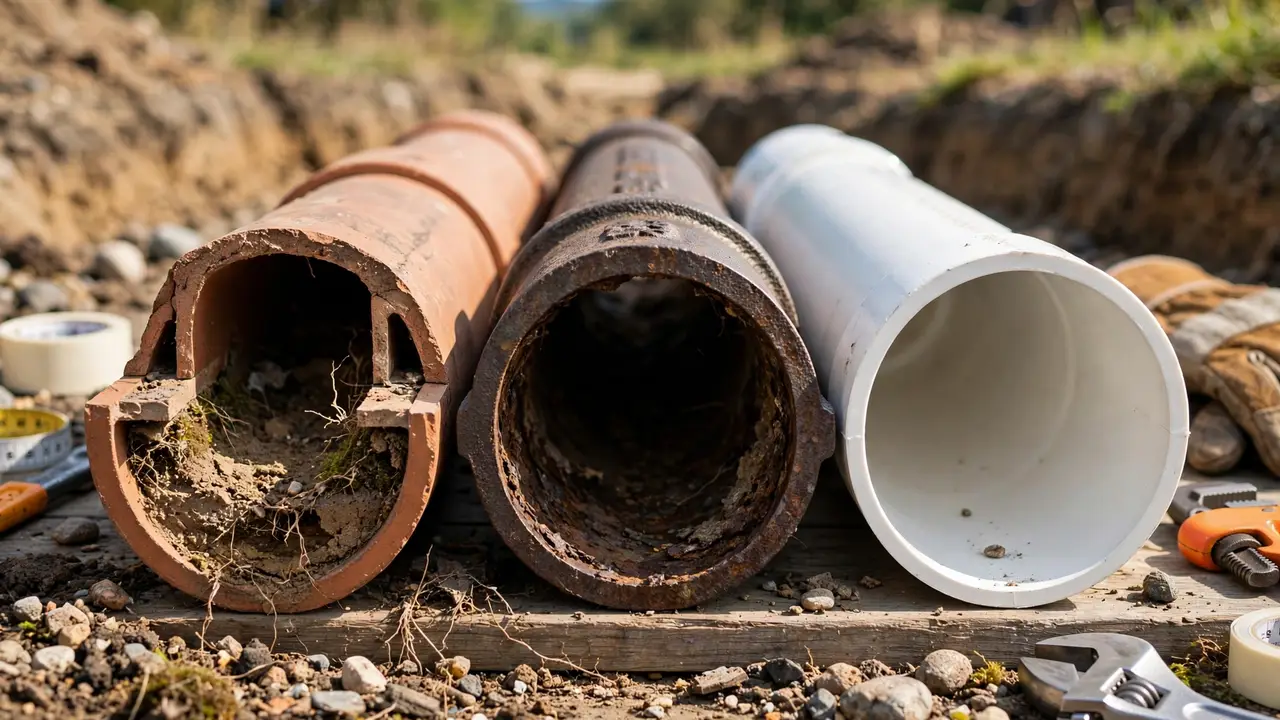
In short: Most Cerritos homes were built in a single great wave — the 1950s, 60s, and 70s tract developments that turned dairy land into subdivisions. That history is written underground: those mid-century laterals are almost always clay tile or cast iron, while homes built from the late 1970s onward typically have plastic pipe (ABS or PVC).
Most Cerritos homes were built in a single great wave — the 1950s, 60s, and 70s tract developments that turned dairy land into subdivisions. That history is written underground: those mid-century laterals are almost always clay tile or cast iron, while homes built from the late 1970s onward typically have plastic pipe (ABS or PVC). All three materials carry wastewater the same way, but they age on completely different schedules, and knowing which one is under your slab or lawn changes how you read warning signs and how you plan a repair.
This guide compares the three materials the way a technician thinks about them: what each one is, how it behaves in LA basin soils and under Cerritos slab foundations, and which repair methods suit each. If you already suspect trouble — slow drains, gurgling toilets, a damp spot along the foundation — a camera inspection will show exactly which material you have and what shape it is in before anyone talks about digging.
Clay tile: the tract-era standard
Clay, or vitrified clay tile, was the default sewer material for the post-war building boom. It is heavy, glazed, and chemically inert — wastewater does not corrode it — and it arrives in short sections, typically three or four feet long, joined with mortar or compression gaskets. In Cerritos, the lateral running from a 1960s ranch to the city main is very often clay from the foundation wall outward. Under the slab itself, the drain layout of that era is usually cast iron, with clay taking over where the pipe exits the house.
Clay's weakness was never the pipe — it was the joints. Every three feet is a seam, and mortar joints from the 1960s have spent sixty years in the ground. Soil movement, even the modest shifting of LA basin soils, cracks mortar; each cracked joint becomes a slow leak that attracts tree roots. Ficus, eucalyptus, and jacaranda — all common in Cerritos parkways — send fine roots toward that moisture, and over seasons the roots pack each joint until the line chokes. A lateral that backs up every year or two is very often a clay lateral with root-filled joints rather than a collapsed line.
Cast iron: under the slab and in the yard
Cast iron shows up in two places in Cerritos homes: as the drain piping cast into or under the slab foundation, and sometimes as the buried lateral itself in slightly older or custom construction. Thick-walled and quiet, it handles hot water and resists crushing, which is why builders trusted it under concrete. The interior of a mid-century cast-iron drain, however, has been collecting deposits for sixty-plus years. Wastewater chemistry and bacteria build rough, rusty scale along the walls — a process that gradually shrinks a four-inch pipe's working diameter and gives every flush more surface to catch on.
Under-slab cast iron fails differently from buried clay. It does not get roots (there are no joints exposed to soil inside the concrete), but it does corrode from the inside out, and the bottom of horizontal runs can channel — wastewater wears a groove along the invert until the pipe thins and splits. Because this piping is encased in the slab, the repair conversation is different: nobody wants to cut open a living-room floor if a trenchless option exists, which is why lining is discussed first for under-slab iron that is still structurally continuous.
PVC and ABS: the modern plastic lateral
Plastic pipe — ABS (the black pipe) in much of Southern California construction, PVC elsewhere — took over residential sewer work in the late 1970s. Nearly every Cerritos home built after about 1980 has a plastic lateral. The appeal is straightforward: the interior stays smooth for the life of the pipe, it cannot rust or scale, and solvent-welded joints leave almost no seam for roots to exploit. In the same soils that punish clay joints and iron interiors, plastic simply does not participate in either failure cycle.
Installation quality matters more with plastic than most homeowners realize. A plastic lateral is only as good as its bedding — the compacted material it rests in — and its slope. Too flat and solids settle; bellied low spots from poor bedding hold standing water that becomes a grease trap. These are workmanship issues, not material defects, which is why the camera footage matters more than the pipe's birth certificate. A well-installed plastic lateral in Cerritos should outlast its owners; a poorly bedded one can develop a belly in its first decade.
How each material fails in LA basin soil
The LA basin's soils — sandy loams and silts with pockets of expansive clay — move less dramatically than the freeze-thaw clays of the Midwest, but they still move. Irrigation cycles, drought years, and the occasional seismic jolt all shift the ground in small increments, and small increments are all it takes. Clay joints crack a little wider. Cast-iron hub joints under the yard shift a fraction of an inch. Plastic pipe, being flexible, usually rides out the same movement — unless a heavy vehicle compacts the soil above a shallow run and ovals the pipe.
Then there is the storm factor. Atmospheric-river events saturate the basin for days, and saturated soil does two things to old sewers: it drives groundwater into every crack and open joint (infiltration that can overwhelm a line during the storm), and it softens the ground around the pipe so marginal sections settle further. The backups that appear every few winters in older Cerritos neighborhoods are often not new damage — they are old joint damage that only shows itself when the soil is waterlogged.
What your pipe material means for repair choices
Material shapes the repair menu. A clay lateral that is still round and continuous — even with heavy root intrusion at the joints — is a strong candidate for epoxy pipe lining: the cured liner bridges every joint with one seamless surface, which is exactly what clay needs. Cast iron under the slab that is scaled but intact is likewise a lining candidate, since lining avoids cutting the floor. When clay has collapsed sections or cast iron has channeled through at the bottom, the conversation shifts to pipe bursting or open-cut replacement, which installs new pipe rather than preserving old.
Plastic laterals, when they fail, usually fail locally: one cracked section, one bad joint, one belly. Spot repairs make sense — expose the bad section, replace it, restore the surface. Full-length lining or bursting on a plastic line is uncommon unless the whole run was poorly installed. Whatever the material, the sequence never changes: diagnose with a camera first, match the repair to the footage, and never agree to a full replacement on symptoms alone. Call (833) 713-2101 to schedule a camera inspection and get video showing your line's material and condition.
Frequently Asked Questions
How can I tell which pipe material my sewer lateral is without digging?
A camera inspection is the reliable answer: clay shows as short segments with visible joints every few feet, cast iron looks rough and dark inside, and plastic looks smooth and light-colored. Your home's age is a strong hint — Cerritos homes built before the late 1970s usually have clay or cast iron, while later construction usually has ABS or PVC.
Can a clay tile lateral be lined instead of replaced?
Often yes. Clay is one of the strongest candidates for CIPP lining, because the liner bridges every joint with a single seamless surface — and the joints are exactly where clay fails. Lining only works if the pipe is still round and continuous; collapsed sections need bursting or open-cut replacement.
Is the black ABS pipe in my home as good as PVC?
For a residential sewer lateral, properly installed ABS performs comparably to PVC. Both are smooth, corrosion-proof plastics with solvent-welded joints. Most failures in either material trace back to installation — poor bedding or flat slope — rather than to the plastic itself.
Do tree roots affect all three materials equally?
No. Clay is the most vulnerable because every joint is a potential entry point. Cast iron resists better, but its hub joints can shift with soil movement and admit roots. Plastic with solvent-welded joints resists roots more effectively than either — roots usually find plastic only at a poorly made joint, a crack, or a transition to older pipe.
My lateral is original 1960s clay. Should I replace it preemptively?
Not necessarily. Get a camera inspection first: a clay line with sound structure and manageable root intrusion can be maintained with scheduled cleaning or lined for a long-term fix. Replacement makes sense when the footage shows collapse, severe offsets, or heavy channeling — not on age alone.
Related reading
Sewer Line Problems Don’t Wait. Neither Should You.
Call now and reach a local sewer line specialist serving Cerritos, CA and nearby northwest suburbs — 24/7.
(833) 713-2101Free to call · No obligation · 24/7 emergency line