
Sewer Pipe Materials: The Complete Guide
From clay tile to PVC, the pipe under your yard determines how it fails and how it can be fixed. A material-by-material guide for Cerritos homeowners.
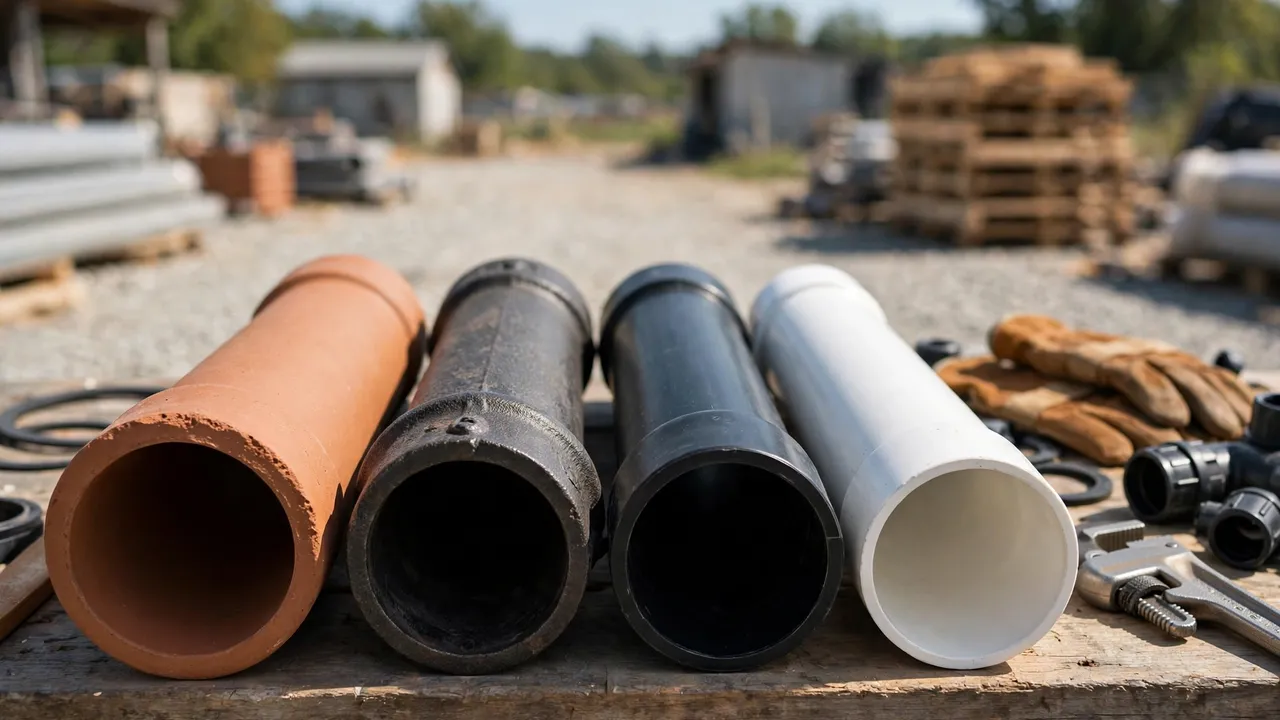
In short: Every sewer lateral in Cerritos belongs to a generation. Homes from the 1950s often have vitrified clay tile; the 1960s and 70s tracts that cover most of the city were plumbed with cast iron, Orangeburg fiber pipe, or ABS plastic; and homes built or repiped from the 1980s onward usually have PVC. Each material carries
Every sewer lateral in Cerritos belongs to a generation. Homes from the 1950s often have vitrified clay tile; the 1960s and 70s tracts that cover most of the city were plumbed with cast iron, Orangeburg fiber pipe, or ABS plastic; and homes built or repiped from the 1980s onward usually have PVC. Each material carries wastewater the same way, but each one ages on its own schedule and fails in its own characteristic pattern — and the repair that makes sense for one can be wrong for another.
This guide walks through the five materials you are most likely to find under a Cerritos yard: what each one is, how it behaves in LA basin soils, how it typically fails, and what that means when a repair is on the table. If you already have symptoms — slow drains, gurgling, soggy patches — a camera inspection will identify your material and its condition before any decisions are made.
Vitrified clay tile: the postwar standard
Vitrified clay — salt-glazed ceramic pipe laid in short sections — was the default sewer material for much of Southern California's postwar building boom. The pipe itself is nearly indestructible: fired clay does not rust, rot, or react with wastewater chemistry, and century-old clay lines still in service are not unusual. The weakness was never the pipe; it was the joints. Each short section was joined with mortar or gaskets, and every joint is a seam where the ground can shift.
In the LA basin's alluvial soils, minor settlement and seismic movement work those joints over the decades. Slight offsets open hairline gaps, and that is all a tree root needs — ficus and eucalyptus roots are remarkably adept at finding the moisture inside a clay joint. A clay lateral that backs up every year or two is often structurally sound pipe with root-packed joints, a very different problem from a collapsed line, and the distinction matters because it changes the repair options completely.
Cast iron: strong, but rusts from within
Cast iron shows up in two places in Cerritos homes: the drain, waste, and vent piping inside the house, and sometimes the first stretch of the underground lateral leaving the foundation. Thick-walled and quiet, cast iron handles hot water and resists crushing under driveways. Its enemy is internal corrosion. Wastewater chemistry and bacterial activity build rough scale — tuberculation — along the interior, gradually choking a four-inch line down to a fraction of its original opening.
Cast iron also suffers at its hubs, the bell-shaped joints where sections meet. Decades of soil movement open these seams just enough for roots to enter, and the rough interior gives grease and solids plenty to cling to. When a cast-iron section is still round and continuous, it is often a candidate for renewal from the inside rather than excavation — epoxy pipe lining creates a smooth new pipe within the old one. When the bottom of the pipe has worn through or sections are missing, replacement is the honest answer.
Orangeburg: the fiber pipe with a clock on it
Orangeburg — bituminous fiber pipe made of wood pulp and tar — was used in some California tracts in the 1950s and 60s as a cheaper alternative to clay and iron. It was never meant to last forever, and in many installations it has not. The pipe wall absorbs moisture over time, softens, and deforms under soil pressure, eventually ovalizing or collapsing outright. If your Cerritos home dates to the early 60s and its lateral has never been replaced, Orangeburg is a real possibility.
There is no rehabilitation story for failed Orangeburg. Once the pipe has deformed, lining cannot restore its shape, and the material continues to deteriorate. Replacement — by trenchless pipe bursting where the run allows, or open-cut excavation where it does not — is the standard recommendation. The consolation is finality: a new plastic lateral installed with proper bedding and slope resets the clock for generations.
ABS: Southern California's black plastic
While much of the country switched to white PVC, Southern California plumbers favored black ABS (acrylonitrile butadiene styrene) through the 1960s, 70s, and 80s — so a large share of Cerritos laterals are ABS rather than PVC. Like PVC, ABS is smooth-walled, corrosion-proof, and joined with solvent cement that leaves almost no seam for roots. A properly installed ABS lateral is a durable, long-lived pipe.
ABS failures are almost always about installation or trauma rather than the material itself. Poor bedding leaves bellies — low spots where water stands and grease accumulates. Heavy loads over shallow burial can crack it. And the transition joints where ABS meets older clay or iron at the house or the city connection are classic root-entry points. The good news is that ABS problems tend to be local: one bad joint, one belly, one cracked section — and local problems invite targeted spot repairs rather than full replacement.
PVC: the modern default
PVC (polyvinyl chloride) is the current standard for new sewer laterals and repipes: smooth interior, immune to corrosion, and gasketed or solvent-welded joints that resist root intrusion far better than clay hubs or iron bells. In the LA basin's soils, PVC simply does not participate in the corrosion cycle that consumes metal pipe, and its flexibility tolerates minor ground movement without cracking.
PVC is not failure-proof. Shallow burial under a driveway invites cracking from vehicle loads. Aggressive chemical drain cleaners and repeated doses of boiling water can damage the pipe wall near the house. And workmanship still rules: flat grades and bellied sections from sloppy bedding cause chronic grease blockages in otherwise perfect pipe. Whatever material is under your yard, the sequence never changes — diagnose with a camera first, then match the repair to what the footage shows.
Frequently Asked Questions
How do I find out what material my sewer line is?
A sewer camera inspection is the reliable method — the camera shows the pipe's interior, and each material has a distinctive look: clay shows segmented joints, cast iron looks rough and dark, Orangeburg appears soft and deformed, ABS is black and smooth, PVC is light and smooth. Your home's build decade is a strong hint, and city building records sometimes note the material.
Which pipe material lasts the longest?
Vitrified clay pipe itself can last a century or more — it is the joints that usually fail first. PVC and ABS are expected to serve many decades because they do not corrode. Cast iron typically serves several decades before internal scaling becomes a problem, and Orangeburg has the shortest expected life of the group.
Can Orangeburg pipe be lined instead of replaced?
Generally no. Lining needs a host pipe that holds its shape, and deformed Orangeburg cannot provide that. Once Orangeburg has ovalized or softened, replacement is the standard recommendation — pipe bursting or open-cut excavation depending on the run.
Does pipe material affect whether trenchless repair works?
Yes. Lining and bursting need a pipe with enough structural integrity to host the process — intact clay, iron, ABS, or PVC with cracks, roots, or scale are usually candidates. Fully collapsed sections, severe bellies that change the grade, or badly deformed Orangeburg usually point to excavation.
My home was built in the 1970s. What material do I probably have?
Most likely ABS or cast iron, possibly clay tile in the yard lateral. Many Cerritos tracts from that era used ABS for the underground run. Only a camera inspection can say for certain — build decade narrows it down, footage confirms it.
Sewer Line Problems Don’t Wait. Neither Should You.
Call now and reach a local sewer line specialist serving Cerritos, CA and nearby northwest suburbs — 24/7.
(833) 713-2101Free to call · No obligation · 24/7 emergency line