
What to Expect During a Sewer Camera Inspection in Cerritos, CA
A camera inspection sends a small waterproof camera through your sewer line so a technician can see cracks, roots, and blockages in real time. Here is how the visit works and what the footage reveals.
In short: If your drains are slow, your toilets gurgle, or one patch of lawn stays suspiciously green, the first recommendation from a plumber is often a sewer camera inspection. The idea is simple: instead of guessing what is wrong underground, a technician feeds a small waterproof camera through your sewer line and watches the inside of
If your drains are slow, your toilets gurgle, or one patch of lawn stays suspiciously green, the first recommendation from a plumber is often a sewer camera inspection. The idea is simple: instead of guessing what is wrong underground, a technician feeds a small waterproof camera through your sewer line and watches the inside of the pipe on a monitor in real time. For Cerritos homeowners, where most houses sit on slab foundations and the lateral runs beneath concrete and landscaping, that look inside is the difference between a targeted fix and an expensive guess.
Knowing what happens during the visit helps you get more from it. This guide walks through the inspection from the technician's arrival to the footage review, explains what the camera typically reveals in Cerritos' 1950s through 1970s tract homes, and covers the questions worth asking before anyone talks about sewer line repair or replacement.
How the appointment begins
The visit usually starts with a short conversation, not with equipment. The technician will ask what you have noticed — which fixtures drain slowly, whether backups follow heavy laundry days, whether the trouble started after one of the winter atmospheric-river storms that saturate LA basin soils. These details tell the technician where to look first and what to expect on the screen, because a line that backs up only during storms points to a different problem than one that gurgles every morning.
Next comes the cleanout, the capped pipe stub that gives direct access to your sewer lateral. In Cerritos' mid-century tracts, the cleanout is often near the front of the house, beside the garage, or just outside the foundation line, sometimes buried under a few inches of soil or hidden by landscaping added decades after the house was built. If the technician cannot find an accessible cleanout, the camera may need to go through a removed toilet instead, which works but takes longer to set up and limits how far the camera can travel.
What the camera sees on its way to the main
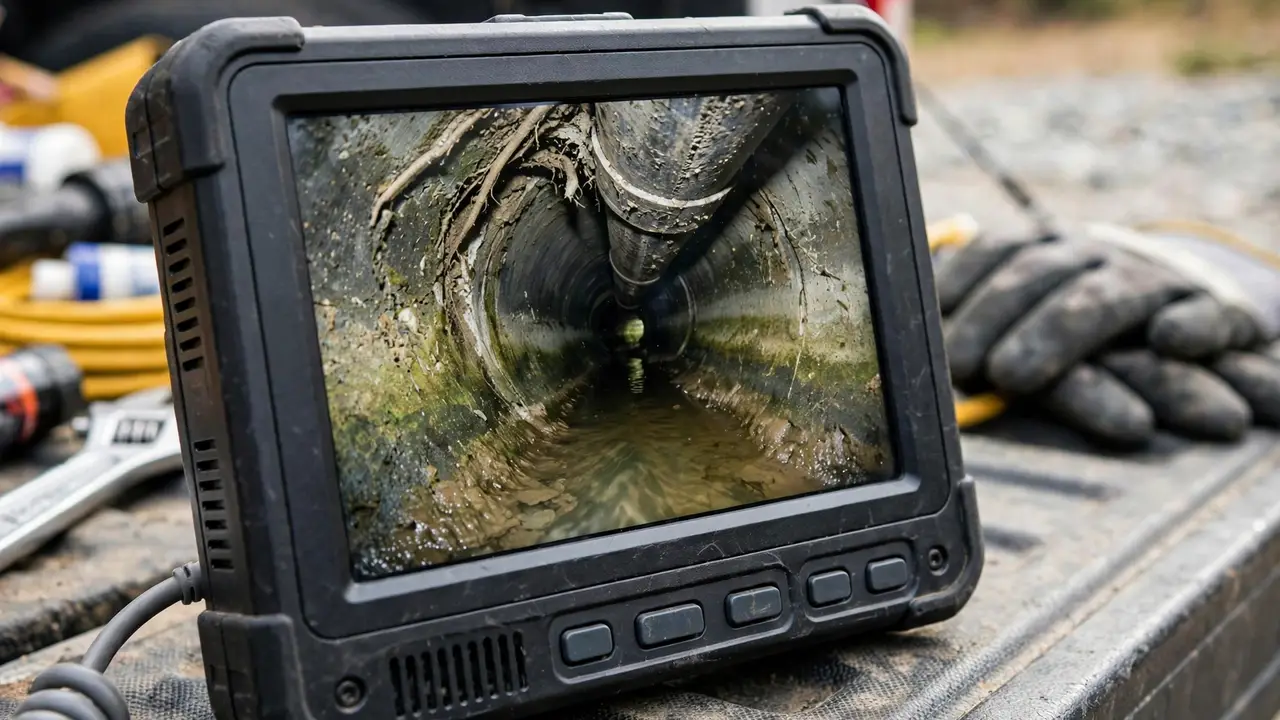
The camera itself is about the size of a golf ball, mounted on the end of a flexible push rod with a footage counter that tracks exactly how many feet it has traveled. As the technician feeds it through the line, you watch the pipe's interior on a monitor: the joints passing by, the color and texture of the pipe wall, and anything that should not be there. The distance counter matters because it lets the technician mark problems by their exact location, such as a root intrusion at forty-two feet, so any later work targets the right spot.
A healthy pipe looks surprisingly uneventful: smooth walls, round shape, water flowing along the bottom. Problems announce themselves visually. Roots appear as pale, hair-like strands hanging from joints that thicken into mats further down the line. Scale and grease narrow the opening. A belly, a low spot where the pipe sags, shows as a section where water sits instead of flowing. Cracks, holes, and separated joints are unmistakable once you have seen them on screen, which is why technicians prefer to review the footage with you rather than only describe it.
Findings that show up often in Cerritos homes
Cerritos' housing stock shapes what the camera finds. Many tracts built from the 1950s through the 1970s have clay tile or cast-iron laterals, and both materials have spent fifty-plus years in LA basin soils that expand when wet and shrink during dry spells. Clay tile fails at the joints: each bell-and-spigot connection is a seam, and decades of soil movement open tiny gaps that thirsty roots exploit. Ficus, eucalyptus, and sycamore trees, all common in Cerritos neighborhoods, are aggressive root producers, and a single mature tree near the lateral's path can fill several joints with root masses.
Cast iron fails differently, from the inside out. Wastewater chemistry builds rough scale along the interior, gradually shrinking a four-inch line's usable opening while the pipe's exterior stays buried and intact. Because most Cerritos homes sit on slabs, the lateral's first stretch runs beneath concrete, which means corrosion or root damage there cannot be spotted from the surface — the camera is often the only way to see it. Technicians also watch for offsets where soil movement has shifted one pipe section relative to the next, a common finding after the ground has been saturated by back-to-back winter storms.
What happens right after the camera comes out
A good inspection ends with a review, not just a verbal summary. The technician walks you through the recording, pointing out each finding and its distance from the cleanout, and explains what each one means in practical terms: which findings are maintenance issues, like light scale that routine sewer line cleaning handles, and which are structural, like a collapsed section or a separated joint. Ask for a copy of the footage, since most companies provide it on a USB drive or a download link, because that recording is your evidence if you ever want a second opinion.
The written report should map findings to options. Light root intrusion at a few joints might lead to a cleaning plus a plan to monitor the line; heavy root mats combined with cracked tile often point toward trenchless pipe lining or a sectional repair; a fully collapsed line under the driveway leaves fewer choices. Be cautious about any recommendation made without footage to back it up. If a company suggests digging before showing you what the camera saw, that is a sign to pause and have the recording reviewed elsewhere.
How to prepare and what to ask for
Preparation is simple: clear access to the cleanout, keep pets out of the work path, and avoid running water for a little while before the appointment so the line is at its normal state. If you know your home's history — a previous backup, a repair done by an earlier owner, a large tree removed from the parkway — share it, because that history helps the technician interpret what the camera shows. Homes without an accessible cleanout should expect the visit to take longer, since toilet access is slower to set up.
Three questions are worth asking every time. First, will you locate findings on the surface, using the camera's transmitter to mark where problems sit in the yard, so any future work digs in the right place? Second, will the line be cleaned before filming if debris blocks the view, since a camera cannot see through standing sludge? Third, what condition would make you recommend trenchless repair over open-trench work for this specific line? The answers tell you as much about the company's approach as the footage tells you about your pipe. Call (833) 713-2101 to schedule an inspection and get footage you can keep.
Frequently Asked Questions
How long does a sewer camera inspection take?
In most homes the camera work itself is finished well within an hour once the cleanout is accessible. Locating a buried cleanout, pulling a toilet for access, or cleaning a heavily blocked line before filming adds time, so the full visit can run longer on older properties.
Will the camera damage my sewer pipe?
No. Push-rod inspection cameras are designed specifically for this job: the camera head is small and smooth, the rod flexes through bends, and the technician controls the feed speed. It is a diagnostic tool, not a cleaning tool, and it does not scrape or cut the pipe wall.
Do I need to be home during the inspection?
It helps to have someone there at the end for the footage review, since seeing the problems on screen makes the findings and options much clearer. The camera work itself does not require your involvement if the technician has access to the cleanout.
Can the camera find a leak under my concrete slab?
Yes. The camera shows cracks, holes, separated joints, and standing water inside the pipe, and the transmitter in the camera head lets the technician mark the exact spot on the surface above. That surface mark is what makes a slab repair targeted instead of exploratory.
How often should a Cerritos home have its sewer line inspected?
For clay tile or cast-iron laterals over forty years old, an inspection every few years is reasonable, especially with mature trees nearby. It is also wise after buying a home, after any backup, and before a major landscaping or driveway project that would cross the lateral's path.
Sewer Line Problems Don’t Wait. Neither Should You.
Call now and reach a local sewer line specialist serving Cerritos, CA and nearby northwest suburbs — 24/7.
(833) 713-2101Free to call · No obligation · 24/7 emergency line