
What Determines the Cost of Sewer Line Repair?
No two sewer repair quotes are alike, because no two lines are alike. The cost factors that matter most in Cerritos — and how to read an estimate line by line.
In short: Ask ten Cerritos homeowners what they paid for sewer line repair and you will hear ten very different answers — and every one of them can be legitimate. A short spot repair on a shallow plastic line and a full-length replacement of a deep clay lateral under a driveway are barely the same category of
Ask ten Cerritos homeowners what they paid for sewer line repair and you will hear ten very different answers — and every one of them can be legitimate. A short spot repair on a shallow plastic line and a full-length replacement of a deep clay lateral under a driveway are barely the same category of work, even though both get called "sewer repair." The final figure follows the work, and the work follows the condition of the line.
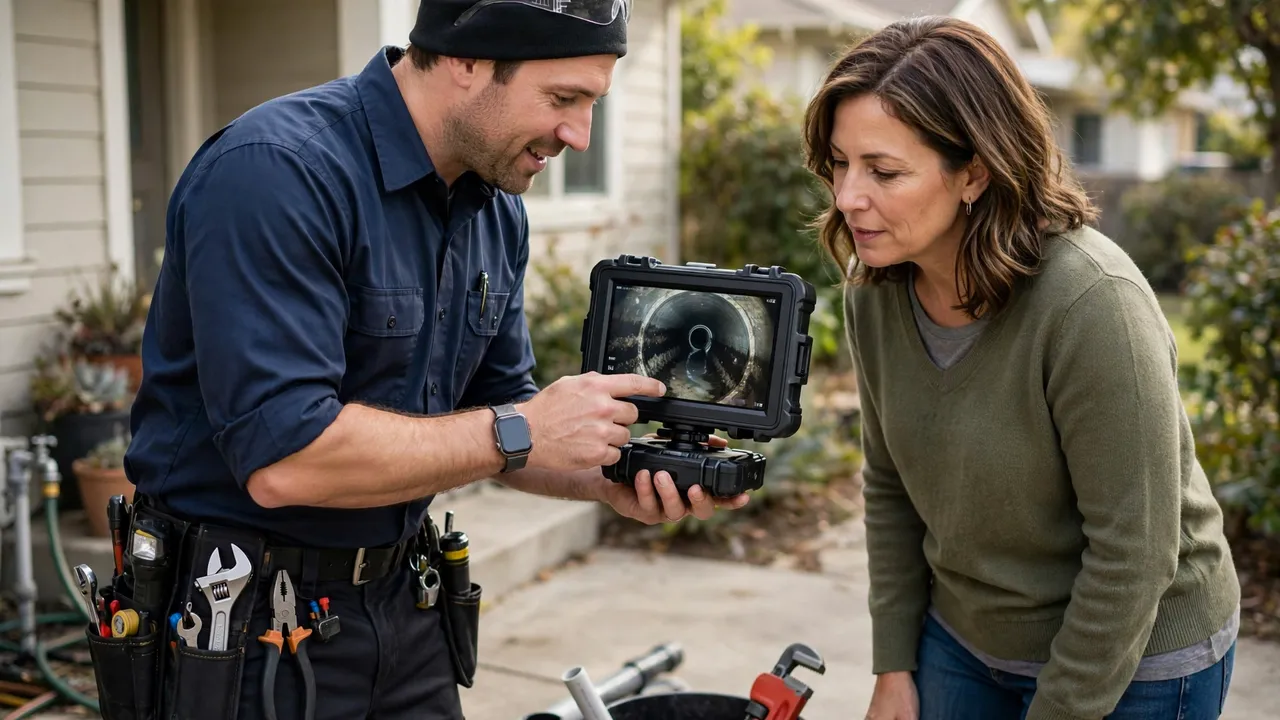
This guide lists no prices — any number printed here would be meaningless without your camera footage. Instead, it explains the factors that drive every quote: the repair method, the length and depth of the line, access conditions, surface restoration, and permits. Understand these, and you can read any estimate line by line and ask the questions that separate a thorough quote from a vague one. For figures tied to your specific line, call (833) 713-2101 for a camera inspection and a written quote based on footage.
Why quotes vary so much: it is the line, not the contractor
Every lateral is a unique combination of material, length, depth, soil, and whatever sits above it. A 1960s clay lateral with root-filled joints under an open lawn, a cast-iron drain channeled beneath a slab foundation, a plastic line with a single belly under a paver patio — each presents a different job with different labor, equipment, and material requirements. Two homes on the same street can have laterals of the same length and still generate very different quotes, because what matters is the pipe's condition, not its address.
This is also why quotes given without camera footage deserve skepticism. A contractor who has not seen inside your line is pricing a guess: the guess might be padded to cover surprises, or lean to win the job and grow later through change orders. Either way, you are not comparing real numbers. The footage turns the quote from speculation into a scope of work, and a scope of work is something you can evaluate.
Repair method: the biggest single factor
The method chosen moves the total more than any other variable. A localized spot repair — excavating one bad section and replacing it — involves the least labor and material. Cured-in-place lining adds specialized resin, liner material, and curing equipment but avoids excavation almost entirely. Pipe bursting requires bursting heads, pulling rigs, and new pipe for the full run. Open-cut replacement of the entire lateral is the most labor-intensive: full excavation, shoring where needed, pipe laying, backfill, and compaction. Each step up in scope brings more crew hours and more material.
Trenchless methods often shift where the money goes rather than simply adding to it. Lining or bursting can reduce or eliminate the surface-restoration portion of the job — no torn-up driveway to repour, no landscaping to rebuild — which is where open-cut projects accumulate significant secondary expense. Our trenchless sewer repair guide explains when the no-dig options apply; the camera footage decides whether your line qualifies.
Length, depth, and access: the quiet multipliers
Length works the way you would expect: more feet of pipe means more material, more labor hours, and more of everything else. But depth is the quieter multiplier. A shallow lateral can be exposed with a small excavator in an afternoon; a deep one requires shoring or stepped trench walls for worker safety, larger equipment, more soil to move and compact, and more inspection hold points. Depth also affects trenchless work — deeper access pits cost more to dig and shore.
Access conditions multiply further. A cleanout at the right location saves an excavation entirely. A narrow side yard with no equipment access means hand work. A line running beneath a slab foundation, a pool deck, or a mature tree that cannot be removed constrains every method and adds protection measures. When reviewing a quote, look for line items that reflect your property's actual access — a quote that ignores a difficult access situation is a quote that will grow.
The restoration costs people forget to ask about
The pipe is only half the project. Everything above it has to be put back: saw-cut concrete repoured and finished, asphalt patched, pavers lifted and relaid, irrigation lines repaired, landscaping replanted, block walls rebuilt where footings were undermined. On open-cut jobs through finished surfaces, restoration can rival the pipe work itself in both time and expense — yet many quotes mention it in a single vague line, or not at all.
Protect yourself by getting restoration in writing as part of the quote: which surfaces will be restored, to what standard, and by whom. Ask whether concrete work is done by the same crew or a subcontractor, and when it is scheduled — restoration that happens weeks later, by someone you have never met, is a common source of disputes. A thorough quote treats the surface with the same specificity as the pipe. If you are weighing sewer line replacement options, compare the restoration scope across quotes, not just the pipe scope.
How to compare quotes fairly
A fair comparison starts with making sure every quote describes the same job. Each estimate should reference the camera footage (ask for the date of the inspection it is based on), name the repair method, specify the pipe material to be installed, state the linear footage covered, list the restoration scope, note who handles permits and inspections, and spell out warranty terms — what is covered, for how long, and what voids it. Quotes missing these elements are not cheaper; they are incomplete.
Watch for the classic red flags: a quote prepared without any camera inspection, a single lump figure with no breakdown, high-pressure tactics to sign the same day, or a price that undercuts every competitor by a wide margin — which usually means something was left out. The goal is not to find the lowest figure but the most complete scope at a fair figure. Three itemized, footage-based quotes will teach you more about your line than any single number could.
Frequently Asked Questions
Why did my neighbor pay so much less for what sounds like the same repair?
Because the lines were not the same. Depth, length, access, surface restoration, and the pipe's actual condition drive the figure far more than the street address. Two laterals of equal length can differ enormously if one runs under open lawn and the other under a driveway and a block wall.
Is trenchless repair more or less costly than traditional digging?
It depends on what you compare. Trenchless methods use specialized materials and equipment, but they typically eliminate most surface restoration — which is where open-cut projects accumulate major secondary expense. On lines under driveways or landscaping, the total project figure often favors trenchless; under open lawn, the gap narrows.
Do I have to replace the whole line, or can just the bad section be repaired?
If the camera footage shows damage confined to one area and the rest of the pipe is sound, a spot repair is legitimate and proportionate. If the footage shows deterioration along the full run — widespread root intrusion, general corrosion — piecemeal repairs become a cycle, and full replacement or lining is the sounder long-term answer.
Are permits and inspections included in a quote?
Sometimes — which is exactly why you should ask. Permit fees and the scheduling of required inspections should appear as explicit line items or a clear statement of who handles them. A quote that ignores permits is either incomplete or expecting you to discover the requirement mid-project.
What should a written quote include at minimum?
The camera inspection it is based on, the repair method, the pipe material and linear footage, the restoration scope, who pulls permits and schedules inspections, the project timeline, payment terms, and warranty terms in writing. If any of these are missing, ask for them before comparing figures.
Sewer Line Problems Don’t Wait. Neither Should You.
Call now and reach a local sewer line specialist serving Cerritos, CA and nearby northwest suburbs — 24/7.
(833) 713-2101Free to call · No obligation · 24/7 emergency line