
How Long Does Sewer Line Replacement Take?
Most Cerritos sewer replacements finish within a few working days — but method, length, depth, and permits move the timeline. What each phase involves and how to plan around the work.
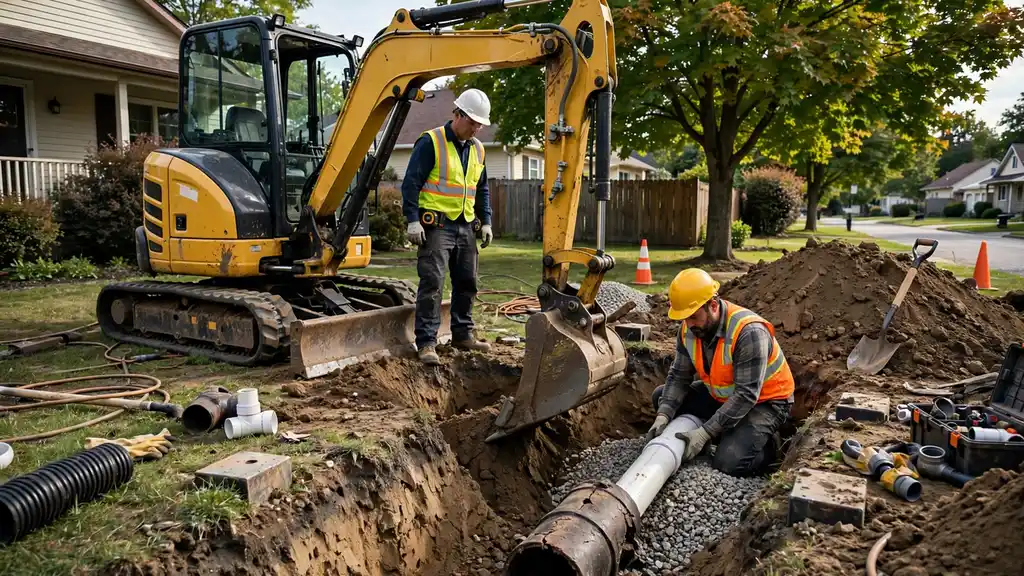
In short: "How long will this take?" is usually the second question Cerritos homeowners ask, right after "what's wrong with my line" — and the honest answer is that it depends on a handful of variables, not on the calendar alone. A short, shallow lateral replaced by pipe bursting can be a one-to-two-day project; a deep line
"How long will this take?" is usually the second question Cerritos homeowners ask, right after "what's wrong with my line" — and the honest answer is that it depends on a handful of variables, not on the calendar alone. A short, shallow lateral replaced by pipe bursting can be a one-to-two-day project; a deep line under a wide driveway, replaced by open trench with city inspections in between, can stretch across a full work week. The method matters most, but it is far from the only factor.
This guide breaks down what sets the timeline: the replacement method, the length and depth of your lateral, access conditions, and the permit and inspection process in Cerritos. It also walks through what a typical project looks like day by day, so you can plan around the work. Sewer line replacement is disruptive by nature, but it is much less stressful when you know the sequence in advance.
The honest short answer: most jobs take one to five working days
For a typical Cerritos residential lateral — 60 to 100 feet from house to city main — the field work usually falls in a familiar range. Pipe bursting, which needs only an entry and an exit pit, commonly finishes the underground work in one to two working days. Open-cut replacement, which excavates the full length of the line, more often runs two to five working days depending on depth, soil, and how much surface has to be cut and restored. These are typical ranges, not promises: your line's specifics move the number within or beyond them.
What the range does not include is everything around the field work. Permit processing happens before the first shovel, required inspections can insert waiting days between phases, and surface restoration — new concrete needs curing time, landscaping needs replanting — extends past the day the pipe itself is done. When a contractor gives you a timeline, ask which parts are included so you are comparing complete pictures.
Method matters most: trenchless vs. open trench
Pipe bursting earns its reputation for speed honestly: the crew digs two pits, threads a cable through the old line, and pulls a bursting head followed by new pipe through the existing path. There is no long trench to excavate, no bedding to place along the full run, no massive backfill to compact in lifts. On a straightforward lateral with good access, the underground portion can genuinely be a single long day of pulling pipe.
Open-cut replacement is slower because every foot of line is exposed, removed, and rebuilt by hand and machine: saw-cutting concrete or asphalt, excavating in layers, shoring the trench walls where depth requires it, laying and bedding new pipe at exact slope, then backfilling and compacting. It is the right method for lines with severe bellies or grade problems — a trench lets the crew correct the slope, which no trenchless method can do — but the thoroughness costs days. Our trenchless sewer repair guide compares the no-dig options in detail.
Length, depth, and what's above the line
Length is simple arithmetic: more feet of pipe means more excavation or more bursting pulls, more material, more joints or fusion welds, and more inspection footage. A 40-foot lateral to a nearby main and a 120-foot lateral crossing a deep lot are different projects wearing the same name. Depth multiplies the effect — trenches deeper than about five feet typically require shoring or sloping for worker safety, and every shoring setup, inspection, and removal adds hours.
Then there is the surface. A lateral under open lawn is the easy case; a lateral under a concrete driveway, a paver patio, a block wall footing, or mature trees is not. Each surface must be cut, protected, or worked around, and then restored afterward — and restoration is often scheduled as a separate phase with its own crew. When you hear a timeline, the question worth asking is: does it include putting my yard back together?
Permits and inspections add calendar days, not work days
In Cerritos, sewer lateral replacement typically requires a city permit, and the permit triggers inspections at defined hold points — commonly an open-trench inspection before backfill and a final inspection of the completed work. The inspections themselves take minutes; the scheduling takes days. A crew that finishes the trench on Tuesday afternoon may wait until Thursday for the inspector, and no backfill happens in between. This is normal, and it is built into honest timelines.
You can keep this phase from dragging by getting the permit process started early — ideally as soon as the camera footage confirms replacement is needed rather than the morning work begins. Having the footage, the planned method, and the pipe specifications ready when the application goes in avoids the back-and-forth that stretches permit review. Ask your contractor who pulls the permit and who schedules the inspections; the answer should be them, not you.
What each day of a typical project looks like
Day one is setup and underground work. The crew locates and marks all utilities, establishes the entry and exit pits (or opens the trench), and performs the replacement itself — bursting the old line and pulling the new pipe, or excavating and laying new pipe section by section. By end of day, the new pipe is typically in the ground and connected at the house end. Expect equipment noise, a work zone in the yard or driveway, and limited use of your plumbing during working hours.
Day two (and beyond, for larger jobs) is connections, verification, and close-up. The crew ties the new lateral into the city main, backfills and compacts, and runs a final camera inspection proving the new line's slope, joints, and connections — ask for a copy of this footage. Surface restoration follows on its own schedule: patch concrete, relay pavers, replant. The project ends with a walkthrough of the footage and the restored surfaces. Call (833) 713-2101 to get a timeline built around your line's actual footage rather than a generic estimate.
Frequently Asked Questions
Will I be without plumbing while the line is replaced?
Usually only during working hours on the days of active replacement. Crews typically restore basic drainage by the end of each workday; the main inconvenience is avoiding heavy water use — laundry, long showers — while the line is open. Your contractor should tell you each morning what to expect that day.
Does pipe bursting really finish faster than digging?
In most residential cases, yes. Bursting needs two small pits instead of a full-length trench, so there is far less excavation, backfill, and surface restoration. Open-cut work is still the right call for lines with grade problems, but on a straightforward lateral, bursting compresses the schedule noticeably.
How much time does the permit process add?
The permit itself is often issued within days of a complete application; the bigger calendar impact comes from required inspections, which can insert waiting days between the trench phase and backfill. Starting the application as soon as the camera footage confirms the plan keeps this from becoming the long pole.
Can the work proceed during rain?
Light rain rarely stops a project, but heavy atmospheric-river storms can — saturated trenches are unsafe to work in and inspections may be postponed. Reputable crews watch the forecast and will tell you honestly if weather pushes the schedule rather than working in unsafe conditions.
When can I drive on my driveway again?
Once backfill is compacted and the surface is patched, foot traffic is fine — but new concrete needs its full curing period before vehicle traffic. Your contractor should give you a specific date for driving on it; parking on fresh concrete too early is one of the most common ways a good restoration gets ruined.
Sewer Line Problems Don’t Wait. Neither Should You.
Call now and reach a local sewer line specialist serving Cerritos, CA and nearby northwest suburbs — 24/7.
(833) 713-2101Free to call · No obligation · 24/7 emergency line