
Commercial Sewer Line Services for Cerritos Businesses
Restaurants, retail centers, and offices put different demands on sewer lines than homes do. What commercial sewer service covers in Cerritos — grease, high-volume flow, and repairs that keep the doors open.
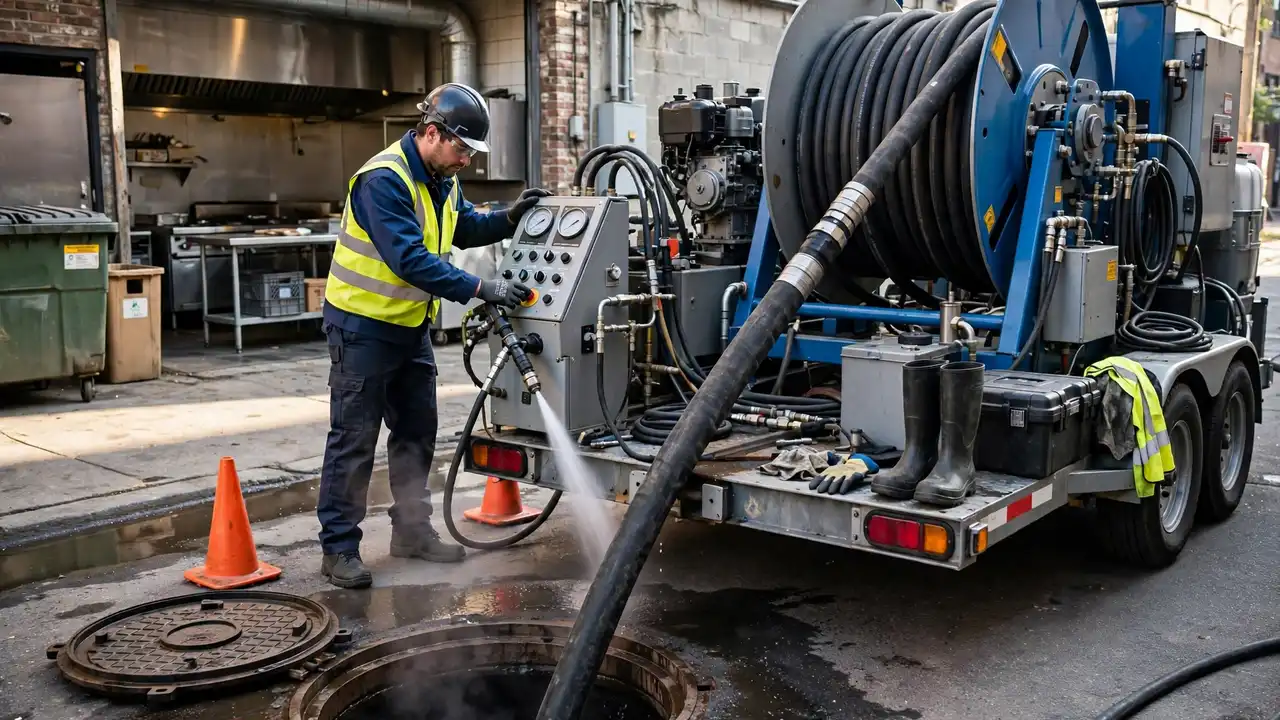
In short: A restaurant on South Street and a single-family home two blocks away both connect to the same city main, but their sewer lines live completely different lives. Commercial lines carry higher volumes, hotter water, and — in food service — fats, oils, and grease that no residential line ever sees. When a commercial line fails,
A restaurant on South Street and a single-family home two blocks away both connect to the same city main, but their sewer lines live completely different lives. Commercial lines carry higher volumes, hotter water, and — in food service — fats, oils, and grease that no residential line ever sees. When a commercial line fails, the stakes are different too: a backup during lunch service does not just inconvenience a family, it closes a business and sends customers elsewhere.
This guide explains what commercial sewer line service actually covers in Cerritos: the problems businesses face, the maintenance that prevents them, and the repair methods that fix a line without tearing up a parking lot or shutting down operations. Whether you manage a restaurant, a retail center, or an office building, scheduled sewer line cleaning and periodic camera documentation are the two habits that separate routine maintenance from emergency calls.
How commercial lines differ from residential ones
Scale is the first difference. A commercial lateral is often six inches or larger in diameter, and in multi-tenant buildings the interior building drain collects from dozens of fixtures before it ever reaches the lateral. More fixtures mean more simultaneous flow, which is actually good for the pipe — strong flow scours the line — but it also means a single blockage affects an entire operation rather than one bathroom. A clogged residential line ruins an evening; a clogged restaurant line ruins a Friday night.
The second difference is what goes down the drain. Commercial kitchens discharge fats, oils, and grease (FOG) that cool and congeal inside the pipe, layer by layer, until the working diameter shrinks dramatically. Office buildings contribute less grease but more paper and higher peak flows. Auto shops and industrial tenants can introduce petroleum and solvents that damage certain pipe materials. Each business type writes its own failure signature into the line, and a service plan should be built around that signature rather than a generic schedule.
Grease: the defining commercial problem
Grease is the number one cause of commercial sewer blockages, and it behaves differently from other debris. Hot grease leaves the kitchen as a liquid, then cools as it travels and plates onto the pipe walls. Over months, the buildup narrows the pipe from the walls inward — a line that started at six inches of open bore can be carrying flow through a two-inch channel. Jetting cuts through this buildup effectively, but grease returns on a predictable cycle, which is why one-time cleaning rarely holds.
Grease interceptors (traps) are supposed to catch FOG before it reaches the sewer, and Cerritos food establishments are generally required to have them. But an undersized, poorly maintained, or bypassed interceptor is the same as having none. Part of a serious commercial service visit is checking the interceptor's condition and pumping schedule alongside the line itself — because jetting a grease-choked lateral without addressing the interceptor is cleaning the symptom while the cause keeps flowing.
Warning signs in a business setting
Commercial warning signs often look different from residential ones. Floor drains that burp or gurgle during peak hours, restrooms on the lowest floor that back up only when the kitchen is running full tilt, a persistent sour odor near the mop sink — these are flow-dependent symptoms that point to a partial blockage rather than a collapse. Because the pattern ties to business activity, staff sometimes normalize it: the drain has always been slow on Fridays, so nobody reports it until the Friday it stops draining entirely.
Property managers should treat any recurring drain complaint as a data point, not an anecdote. Two slow-drain tickets from different tenants in the same month, or a restroom backup that coincides with heavy kitchen use, justify a camera inspection before the next busy period. Footage from that inspection becomes a baseline — the next inspection, a year later, shows whether the line is stable or deteriorating, and that comparison is what turns reactive plumbing into planned maintenance.
Repairs that keep the doors open
The central constraint of commercial sewer work is continuity: the business needs to keep operating. That constraint favors trenchless methods. Trenchless sewer repair renews or replaces a lateral through small access points instead of an open trench, which means the parking lot stays usable, the dining room stays open, and the work can be scheduled during low-traffic windows — overnight or between service periods — rather than shutting the property down for days.
For lines with root intrusion or scale but sound structure, lining creates a new jointless interior without excavation. For collapsed or undersized lines, pipe bursting pulls a new, often larger-diameter pipe through the old path. And for grease-choked lines with no structural damage, scheduled jetting on a maintenance interval is the correct prescription — a repair is not needed, a program is. The right recommendation always starts with camera footage, because guessing wrong on a commercial property costs far more in lost business than the inspection ever could.
Documentation, compliance, and the paper trail
Commercial properties generate paperwork that homes do not, and sewer service should feed into it. Keep the camera footage from every inspection, the service report from every cleaning, and the interceptor pumping records in one file. If a backup ever affects a neighboring tenant or a customer, that file is your evidence of diligent maintenance. If you sell the property, it is documentation a buyer will pay attention to.
Cerritos businesses should also know where their responsibility ends. In most cases the property owner maintains the lateral from the building to the city main — including the portion under the sidewalk and street — while the city maintains the main itself. When a problem sits near the connection point, a camera inspection that shows exactly where the defect lies settles the question of who fixes it before anyone starts digging in the public right-of-way. Call (833) 713-2101 to set up an inspection and a maintenance schedule sized to your business type.
Frequently Asked Questions
How often should a restaurant have its sewer line jetted?
It depends on volume and grease-trap performance, but many busy kitchens settle on a quarterly to semiannual interval. The first camera inspection establishes how fast grease rebuilds in your specific line; the schedule is then tuned to clean before flow is restricted — not after a backup forces the issue.
Can sewer work be done without closing my business?
In most cases, yes. Trenchless methods need only small access points, and cleaning or lining can be scheduled during low-traffic windows — overnight or between service periods. The main exception is a full open-cut replacement across a parking lot, which requires staging and partial closures.
Who is responsible for the lateral — the landlord or the tenant?
It depends on the lease, but the property owner is generally responsible for the lateral to the city main in Cerritos, including the section under the sidewalk and street. Tenants are typically responsible for blockages their operations cause, such as grease misuse. Clear lease language plus shared camera footage prevents most disputes.
My grease trap is pumped on schedule — why does the line still clog?
A pumped trap only helps if it is correctly sized, properly installed, and actually capturing grease before the sewer connection. Undersized traps, traps bypassed during remodels, or staff pouring grease down drains overwhelm the system regardless of pumping. A camera inspection reveals whether the line or the trap is the weak link.
What if the problem is in the city main, not my lateral?
Then the city repairs it — but you need proof of where the defect lies. A camera inspection that locates the blockage or break relative to your property line settles responsibility before anyone excavates in the public right-of-way.
Related reading
Sewer Line Problems Don’t Wait. Neither Should You.
Call now and reach a local sewer line specialist serving Cerritos, CA and nearby northwest suburbs — 24/7.
(833) 713-2101Free to call · No obligation · 24/7 emergency line